The AI Shock Is About to Break the Federal Reserve

The Illusion of Control
The Federal Reserve likes to project certainty.
Models. Forecasts. Neutral rates. Dot plots.
But what happens when the economy shifts faster than the models can process?

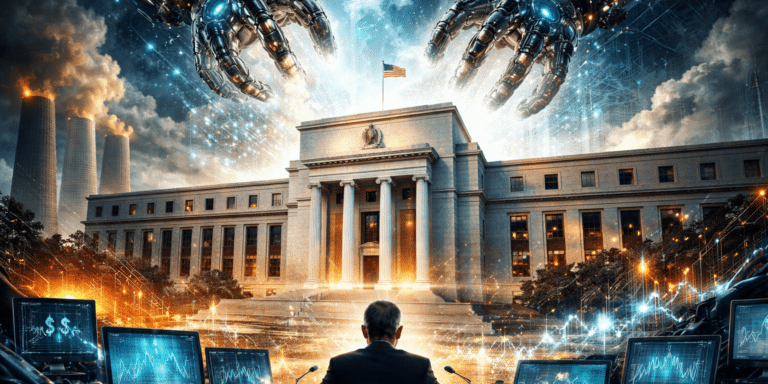
Artificial intelligence is doing exactly that.
We are witnessing one of the largest capital spending booms in modern history. Data centers are rising across America. Semiconductor plants are absorbing billions in subsidies. Electricity demand — once flat for years — is surging again.
And central bankers are staring at dashboards that no longer behave predictably.
The question is no longer “What is inflation doing?”
The question is: What is AI about to do next?

Productivity Boom — or Statistical Mirage?
Some policymakers argue AI will trigger explosive productivity gains.
If machines produce more output per worker, the economy can grow faster without inflation. That would justify lower rates — even amid strong GDP numbers.
This is the optimistic scenario.
Kevin Warsh and others suggest AI could unlock non-inflationary growth at scale.
But here’s the uncomfortable reality:
Productivity booms don’t show up instantly.
They take years to materialize.
And they rarely distribute evenly.
In the short term, what we’re actually seeing is a spending frenzy.
Billions poured into chips.
Power grids strained.
Construction labor stretched thin.
In Cedar Rapids, HVAC workers are being pulled into data center projects. Costs are rising. Local employers can’t compete.
That’s not deflationary.
That’s inflationary pressure.
So which signal should the Fed follow?
Future productivity dreams — or present price spikes?
The Neutral Rate Trap
There’s another layer most headlines miss.
When investment demand surges, the so-called “neutral rate” rises. That’s the interest rate that neither stimulates nor restrains growth.
If AI drives sustained capital demand, the equilibrium interest rate could be structurally higher.
That would mean:
Rates staying elevated
Credit remaining tight
Asset valuations adjusting
But what if the productivity payoff eventually floods the system with output?
Then rates might need to fall.
Do you see the trap?
Raise rates too long — you crush growth.
Cut rates too soon — inflation reignites.
The Fed isn’t steering a stable ship anymore. It’s reacting to technological shockwaves in real time.
The Employment Wildcard
Here’s where it gets more volatile.
If AI dramatically reduces labor demand in white-collar and technical sectors, unemployment could spike.
Not gradually.
Abruptly.
The historical playbook says rate cuts help ease labor transitions.
But what if AI-driven job losses are structural?
What if entire categories of work shrink permanently?
Rate cuts can stimulate demand.
They cannot create relevance.
And if the Fed cuts aggressively to combat unemployment while AI infrastructure spending continues pushing prices up?
You get the worst-case scenario:
Stubborn inflation
Rising unemployment
Policy paralysis
Central bankers call this a “crosscurrent.”
I call it exposure.
Exposure of a system designed for cyclical slowdowns — not technological disruption at warp speed.
Inflation in Disguise
There’s another dimension few are discussing.
AI infrastructure is extraordinarily capital-intensive.
It concentrates wealth.
Mega-cap firms absorb resources.
Energy grids are reprioritized.
Supply chains reorient around silicon and servers.
When capital pools at the top while labor faces displacement, consumption patterns distort.
Asset inflation can surge even while wage pressure cools.
The Fed may celebrate lower headline CPI — while asset bubbles quietly rebuild.
Sound familiar?
We’ve seen this movie before.
The Real Risk: Policy Overreach
When central banks face uncertainty, they tend to do one thing:
Intervene more.
If AI creates instability — economic, labor, or financial — the pressure for new policy tools increases.
Liquidity facilities.
Credit backstops.
Digital infrastructure experiments.
Moments of disruption are historically when financial systems evolve fastest.
The Fed doesn’t like ambiguity.
And AI is pure ambiguity.
What This Means Going Forward
Let me show you the bigger picture.
AI is not just a productivity story.
It is:
- An inflation story (short-term supply constraints)
• A rate story (neutral rate shifts)
• A labor story (structural displacement risk)
• And potentially a financial system story
The second half of the 2020s will likely be defined by how central bankers respond to this shock.
And here’s the uncomfortable truth:
They don’t know yet.
They are navigating without precedent.
Which means volatility is not a side effect.
It’s the baseline.
The Defining Question
Will AI allow non-inflationary growth and justify lower rates?
Or will it create inflationary bottlenecks and labor displacement that force policy whiplash?
The honest answer is:
Both forces can happen — on different timelines.
And when monetary policy is trying to hit a moving target influenced by technological acceleration, mistakes become more likely.
The era of predictable rate cycles may be over.
Final Thought
Artificial intelligence may revolutionize productivity.
But it may also expose the limits of centralized monetary management.
When capital surges, labor shifts, and inflation signals conflict, the illusion of precise control begins to crack.
The Fed is entering its most uncertain decade in modern history.
The question isn’t whether AI complicates things.
The question is whether the institution built for 20th-century economics can manage a 21st-century technological shock.
And that — far more than dot plots or press conferences — will shape the financial future ahead.
If there’s one thing this AI-driven upheaval makes clear, it’s this: the financial system you depend on is entering a period of profound instability. When central bankers themselves admit they don’t know whether rates should be higher or lower — or when — that’s your signal to prepare.
Don’t wait for policy confusion, inflation shocks, or labor displacement to hit your household unannounced. Take control now.
Download the Digital Dollar Reset Guide by Bill Brocius and learn the practical steps you can take to protect your savings, shield your assets, and position yourself ahead of the coming monetary transformation.
The system is evolving fast. The only question is whether you will evolve with it — or be caught off guard when the next shift hits.