The Federal Reserve's Trust Deficit: A Deep Dive into Plummeting Public Confidence

EDITORS NOTES: In a stunning testament to the perceived failures of the Federal Reserve, recent findings reveal that public confidence in Fed chairman has hit a staggering low. This alarming decline exposes a deep-seated public mistrust that harks back to decades-old grievances, as well as newly minted concerns brought on by the Fed's controversial policies.
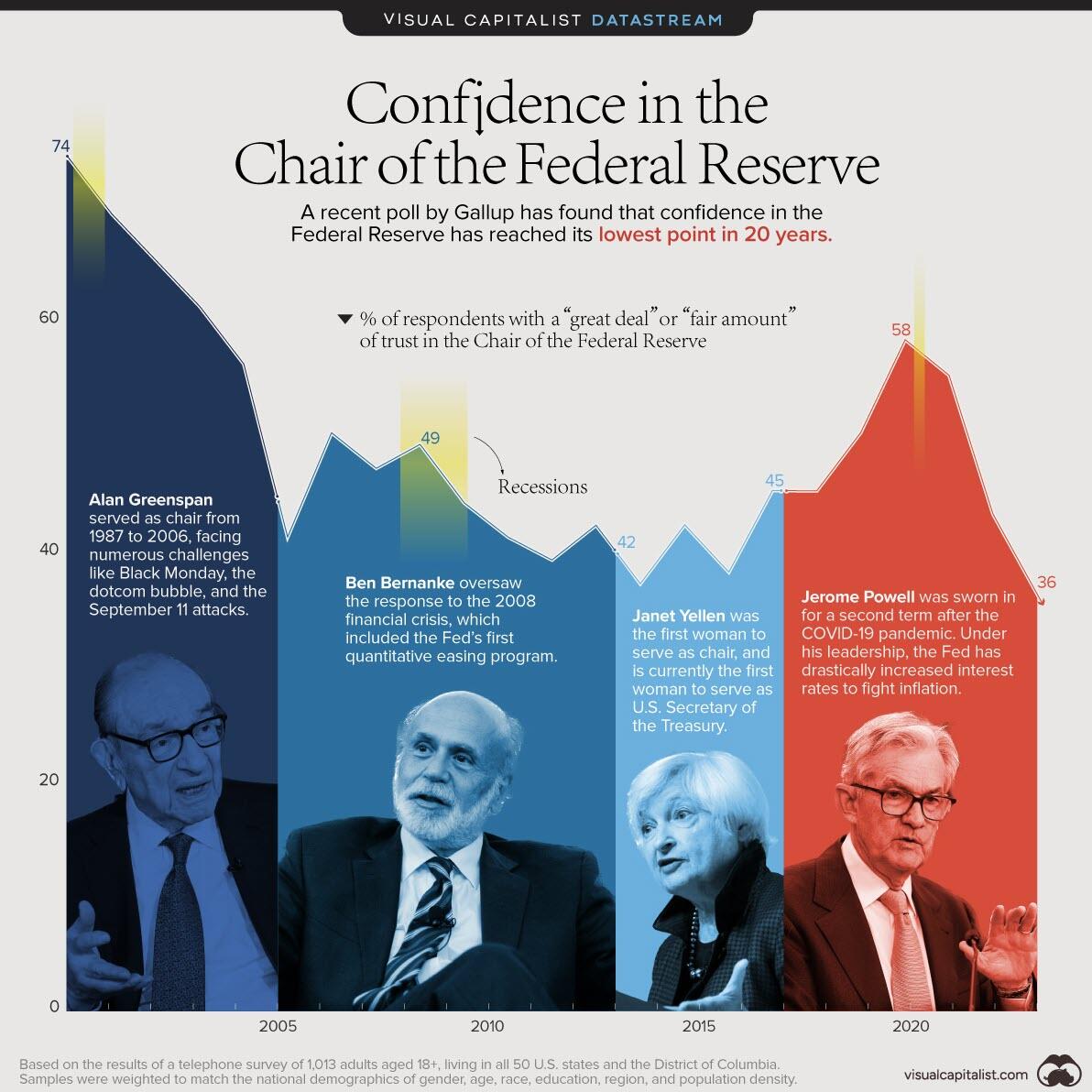
Each year, Gallup surveys American adults on their confidence in the Fed Chairman's ability to do right by the U.S. economy. Today, the results are distressingly clear. Confidence in Jerome Powell has plummeted from a relative high of 58% in 2020 to a mere 36% in 2023 - the lowest number in 20 years. This seismic shift in public sentiment can be attributed to a variety of factors, chief among them being Powell's aggressive and arguably misguided attempts to combat post-pandemic inflation. Yet, despite the Fed's insistence on its necessity, these rapid-fire rate hikes have triggered a host of damaging consequences, thereby sowing the seeds of distrust among an increasingly wary public.
Each year, Gallup conducts a survey of American adults on various economic topics, including the country’s central bank, the Federal Reserve.
More specifically, respondents are asked how much confidence they have in the current Fed chairman to do or recommend the right thing for the U.S. economy.
Visual Capitalist's Marcus Lu and Bhabna Banerjee visualized these results from 2001 to 2023 to see how confidence levels have changed over time.

Methodology and Results
The data used in this infographic is also listed in the table below. Percentages reflect the share of respondents that have either a “great deal” or “fair amount” of confidence.
| Year | Fed chair | % Great deal or Fair amount |
|---|---|---|
| 2023 | Jerome Powell | 36% |
| 2022 | Jerome Powell | 43% |
| 2021 | Jerome Powell | 55% |
| 2020 | Jerome Powell | 58% |
| 2019 | Jerome Powell | 50% |
| 2018 | Jerome Powell | 45% |
| 2017 | Janet Yellen | 45% |
| 2016 | Janet Yellen | 38% |
| 2015 | Janet Yellen | 42% |
| 2014 | Janet Yellen | 37% |
| 2013 | Ben Bernanke | 42% |
| 2012 | Ben Bernanke | 39% |
| 2011 | Ben Bernanke | 41% |
| 2010 | Ben Bernanke | 44% |
| 2009 | Ben Bernanke | 49% |
| 2008 | Ben Bernanke | 47% |
| 2007 | Ben Bernanke | 50% |
| 2006 | Ben Bernanke | 41% |
| 2005 | Alan Greenspan | 56% |
| 2004 | Alan Greenspan | 61% |
| 2003 | Alan Greenspan | 65% |
| 2002 | Alan Greenspan | 69% |
| 2001 | Alan Greenspan | 74% |
Data for 2023 collected April 3-25, with this statement put to respondents: “Please tell me how much confidence you have [in the Fed chair] to recommend the right thing for the economy.”
We can see that trust in the Federal Reserve has fluctuated significantly in recent years.
For example, under Alan Greenspan, trust was initially high due to the relative stability of the economy. The burst of the dotcom bubble—which some attribute to Greenspan’s easy credit policies—resulted in a sharp decline.
On the flip side, public confidence spiked during the COVID-19 pandemic. This was likely due to Jerome Powell’s decisive actions to provide support to the U.S. economy throughout the crisis.
Measures implemented by the Fed include bringing interest rates to near zero, quantitative easing (buying government bonds with newly-printed money), and emergency lending programs to businesses.
Confidence Now on the Decline
After peaking at 58%, those with a “great deal” or “fair amount” of trust in the Fed chair have tumbled to 36%, the lowest number in 20 years.
This is likely due to Powell’s hard stance on fighting post-pandemic inflation, which has involved raising interest rates at an incredible speed. While these rate hikes may be necessary, they also have many adverse effects:
-
Negative impact on the stock market
-
Increases the burden for those with variable-rate debts
-
Makes mortgages and home buying less affordable
Higher rates have also prompted many U.S. tech companies to shrink their workforces, and have been a factor in the regional banking crisis, including the collapse of Silicon Valley Bank.
Originally posted on Zero Hedge