The Fed’s Greatest Fear: Trump Might Expose the Lie

Trump’s War on the Fed: The Official Narrative
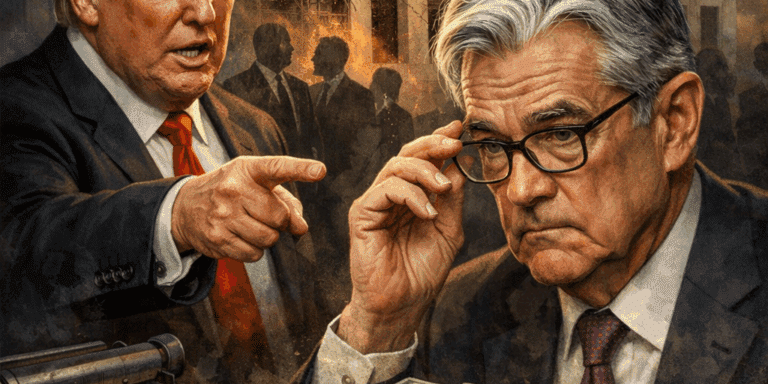
In early 2026, Donald Trump’s Department of Justice served Federal Reserve Chair Jerome Powell with grand jury subpoenas. The charge? Allegedly lying to Congress about the Federal Reserve’s billion-dollar renovation of its Washington, DC headquarters—the Eccles Building. Publicly released Federal Reserve budget filings show the project’s cost ballooned to more than double its original estimate, ultimately surpassing $2 billion, raising bipartisan questions about transparency and oversight. What appears on the surface as a dispute over construction spending has quickly escalated into something far larger: Trump versus Federal Reserve, a confrontation that exposes how deeply political the central bank has always been—despite its carefully maintained image of independence.
To the public, this looks like a fiscal accountability move. Trump’s allies framed it as a crackdown on wasteful spending and mismanagement. But anyone paying attention sees through it. Trump, the real estate tycoon famous for gold-plated elevators and billion-dollar skyscrapers, isn’t suddenly allergic to opulence.
This isn’t about cost overruns. It’s about leverage. It’s about control. And above all, it’s about exposing what the Federal Reserve actually is—a political creature cloaked in false neutrality.

Fed Independence: A Carefully Constructed Myth
The central claim of the Mises article—and one I emphatically echo—is that the Federal Reserve's “independence” has never been real. It's branding. Optics. A deception designed to prevent the American people from realizing they’re being quietly robbed by a monetary system that inflates away their purchasing power to fund wars, bailouts, and Wall Street.
In fact, the very design of the Eccles Building was part of this image management. Built in the 1930s, its stripped-down neoclassical architecture was deliberately crafted to appear authoritative, yet modest—governmental, but distinct from the grandiosity of other federal institutions. This wasn’t just about aesthetics. It was psychological warfare on the public’s perception.
As the Mises piece lays out, this illusion was reinforced by the so-called “Treasury-Fed Accord” of 1951, which supposedly ended political interference in the Fed. But in reality, the central bank continued to serve political ends—quietly funding government debt and lubricating the machinery of empire—all while maintaining the public image of impartial, data-driven stewardship.
Why the Fed Is Really Worried About Trump
So why is the central banking elite so spooked by Trump?
It’s not because he’s threatening the Fed’s neutrality. It’s because he’s threatening to unmask the lie. Trump, in his usual bombastic style, is dragging the Fed into the political arena where it truly operates—but was never supposed to be seen.
The article points to a joint statement by every living Fed chair and former monetary official, lamenting the attack on the “public’s perception of [Fed] independence.” That phrasing says it all. The concern is not the actual loss of independence—it’s the loss of public belief in it.
That belief is what grants the Fed its real power. Without it, the institution becomes just another political agency—an unelected one, printing trillions and distorting markets in the shadows.
What Trump Gets Right—and What He Gets Wrong
Let’s be clear: Trump is not a monetary reformer. He’s not trying to decentralize power or restore sound money. His goal is accelerated monetary manipulation—cheap money, inflated markets, and short-term sugar highs to fuel his agenda.
But in the process, he may do something unintentionally valuable: he may force the American people to confront the truth about the Fed. That it has never been apolitical. That it serves elites, not citizens. That inflation isn’t a mistake—it’s policy.
The danger is, Trump’s version of policy—more inflation, more debt, more crony capitalism—won’t save the system. It will deepen the rot. And that’s the paradox: Trump is both the accelerant and the exposer. The one man reckless enough to torch the illusion—and maybe, just maybe, bring down the temple with it.
The Strategic Takeaway: Trust Is the Fed’s Weak Spot
The Federal Reserve’s strength doesn’t lie in its balance sheet. It lies in belief—the collective myth that it stands above politics, serving the economy with sober judgment. That myth has allowed it to engineer bailouts, prop up bubbles, and monetize trillions in debt with minimal pushback.
But once that myth is shattered, once the average American sees the Fed for what it truly is—a cartel managing currency for the benefit of insiders—the game changes. And the monetary reset begins.
That’s why they fear Trump. Not because he’ll politicize the Fed. But because he’ll expose that it already is.
Final Warning
We are fast approaching the moment when monetary manipulation will no longer be hidden behind economic jargon and “expert” panels. The financial elite know this—and they’re scrambling to protect their narrative.
You don’t have to wait for the collapse to be caught off guard.
Download the Digital Dollar Reset Guide and prepare now. Understand how digital currencies, inflationary bailouts, and central bank control mechanisms are converging into a new financial order—one where your autonomy will be tested like never before.
The clock is ticking.