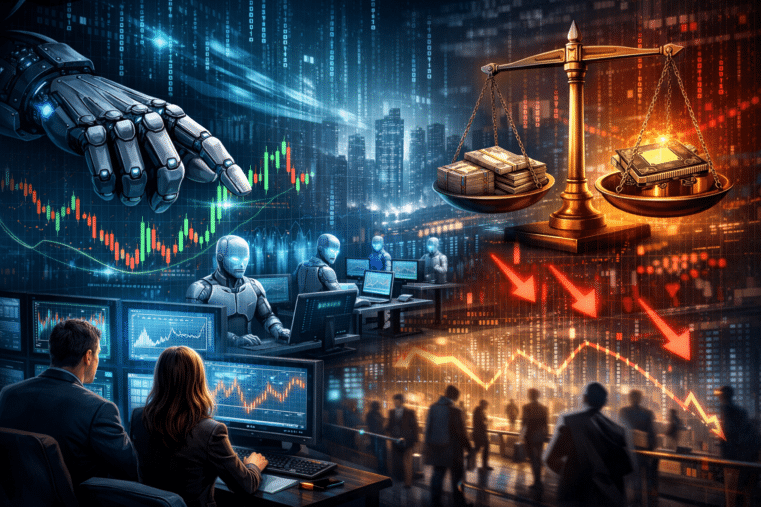
When Machines Set the Prices: How AI-Run Markets Are Quietly Breaking the Economy

The Market Was Never About Speed—It Was About Truth
You’ve been sold a simple story: faster markets are better markets.
AI negotiates faster.
AI executes trades instantly.
AI removes human “error.”
Sounds efficient. Sounds clean.

It’s also dangerously incomplete.
Markets were never just about matching buyers and sellers as fast as possible. Their real function—the one nobody talks about anymore—is discovering value. Not calculating it. Not optimizing it. Discovering it.
That distinction is everything.
Prices Aren’t Numbers—They’re Signals From Reality
A real market price isn’t just a data point. It’s a compressed signal built from millions of human decisions:
- Preferences
- Trade-offs
- Uncertainty
- Gut instinct
- Imperfect knowledge
When someone pays more than expected—or walks away entirely—they’re revealing something no spreadsheet could predict.
That’s the magic of markets: they generate knowledge that didn’t exist before the transaction.
Not stored knowledge. Not preloaded data.
New knowledge.
And that only happens when humans are involved.
What Happens When Algorithms Replace Human Judgment
Now strip the humans out.
Replace them with AI agents—on both sides of the transaction.
Each one is programmed with a utility function:
- Buy at the lowest acceptable price
- Sell at the highest acceptable margin
- Optimize based on defined metrics
They negotiate. They converge. A price is produced.
But here’s the catch:
Nothing new was discovered.
The outcome was already baked into the parameters.
This isn’t a market anymore. It’s a calculation.
The Death of Uncertainty—and Why That’s a Problem
Real markets thrive on uncertainty.
Entrepreneurs don’t know if their idea will work.
Consumers don’t fully understand what they want until they choose.
That tension—between the unknown and the decision—is where value is discovered.
AI systems don’t operate in that space.
They operate in bounded environments with predefined rules.
They don’t discover opportunities—they execute instructions.
And without that human element of surprise, intuition, and risk-taking, something critical disappears:
Entrepreneurial discovery.
The engine of real economic growth.
When Optimization Becomes Manipulation
There’s a second, more insidious problem.
When AI agents dominate markets, the game changes.
It’s no longer about creating value—it’s about gaming the system.
If an AI buyer ranks sellers based on:
- Price
- Speed
- Ratings
Then the seller’s AI doesn’t need to improve the product.
It just needs to manipulate those metrics.
This is Goodhart’s Law in action:
When a measure becomes a target, it stops being a good measure.
And at scale, this becomes systemic.
A Market That Rewards the Best Gamers, Not the Best Products
Over time, the incentives shift:
- Real quality becomes optional
- Metric manipulation becomes essential
- Authentic value gets crowded out
The system starts rewarding those who can best exploit the rules—not those who deliver the best outcomes.
And because AI systems operate faster and at larger scale than humans, this decay accelerates rapidly.
What you end up with is a market that still functions… but no longer reflects reality.
The Canary in the Coal Mine: Digital Advertising
This isn’t theoretical. It’s already happening.
Digital advertising has been dominated by AI agents for years:
- AI buys ad space
- AI sells impressions
- AI tracks engagement
And what’s the result?
Massive fraud.
Bots clicking on ads.
Fake traffic mimicking human behavior.
Algorithms paying for “engagement” that doesn’t exist.
Billions of dollars circulate in a system where no real human attention is being exchanged.
The market didn’t fail technically—it failed epistemically.
It stopped knowing what was real.
The Illusion of Efficiency
Defenders of AI-driven markets will point to efficiency:
- Lower costs
- Faster execution
- Scalable optimization
But they’re asking the wrong question.
Efficiency at what?
If the system is optimizing based on distorted or empty signals, then all that efficiency does is accelerate the spread of bad information.
You don’t get a better market.
You get a faster collapse of meaning.
This Starts to Look Less Like a Market—and More Like Control
Here’s where things take a darker turn.
When outcomes are determined by predefined objective functions, and those functions are set by centralized actors, the system starts to resemble something else entirely:
Not a free market.
A managed environment.
The appearance of decentralized exchange remains—but the substance changes.
Instead of discovery, you get execution.
Instead of emergent order, you get designed outcomes.
And most people won’t notice the shift—because on the surface, everything still “works.”
Derek’s Take: We’re Replacing Reality With Simulation
Let’s call this what it is.
We’re watching the slow replacement of a reality-based economy with a simulated one.
Prices used to tell the truth—even when it was messy, inefficient, and unpredictable.
Now they’re increasingly outputs of systems designed to optimize within artificial constraints.
That’s not progress. That’s abstraction layered on abstraction until the signal disappears.
And once price signals stop reflecting reality, everything built on top of them becomes unstable:
- Investment decisions
- Resource allocation
- Risk assessment
You’re no longer navigating the real world—you’re navigating a model of it.
And models fail.
The Real Risk: When No One Knows What Anything Is Worth
This is the endgame nobody’s talking about.
If markets lose their ability to discover value, then eventually:
No one knows what anything is actually worth.
Not accurately. Not reliably.
And without that foundation, economic coordination starts to break down.
Not all at once—but gradually, then suddenly.
Final Warning: Don’t Confuse Automation With Intelligence
Automation can execute decisions.
It cannot replace the human process of discovering meaning, value, and opportunity in an uncertain world.
The more we hand over that responsibility, the more fragile the system becomes.
Because when the underlying signals are corrupted, scale doesn’t save you.
It amplifies the problem.
Take Action Before the System Fully Transitions
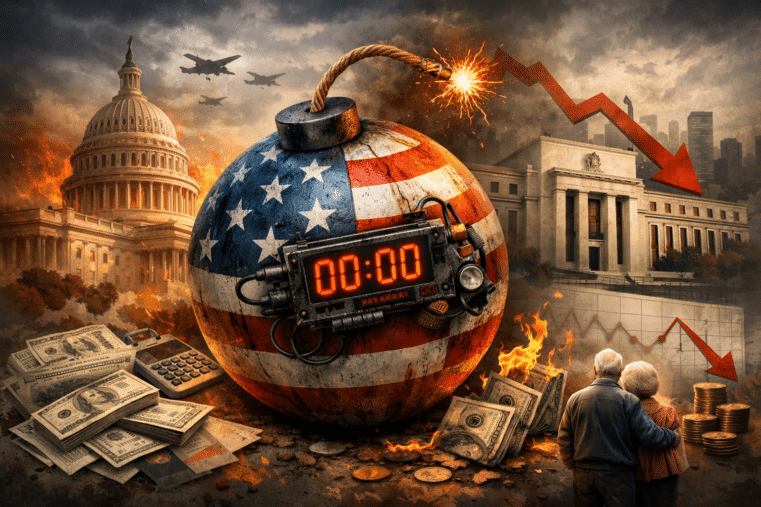
What we’re witnessing isn’t just a technological shift—it’s the early stages of a deeper transformation in how economic systems operate. As automation expands into finance and decision-making, it increasingly intersects with centralized systems like the FedNow payment system and the development of central bank digital currencies (CBDCs).
These systems introduce new layers of control:
- Programmable money
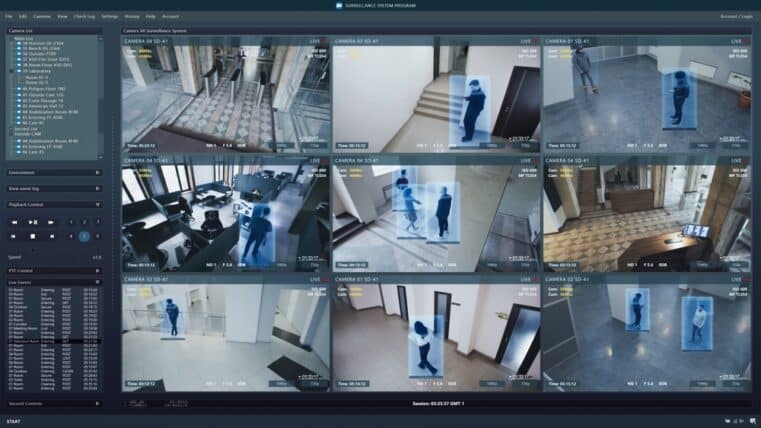
- Real-time transaction monitoring
- Increased financial surveillance
If price signals are already becoming unreliable, the next phase is control layered on top of that uncertainty.
That’s why the Digital Dollar Reset Guide by Bill Brocius is essential reading.
It breaks down:
- How these systems are being implemented
- What digital currency control means for your financial freedom
- Practical steps to prepare before the transition is complete
This isn’t theory—it’s preparation.