Red vs. Blue Theater: Spanberger’s Rebuttal to Trump Proves Washington Still Won’t Shrink Itself

Spanberger’s Questions — And the One She Didn’t Ask
Governor Spanberger stood in Colonial Williamsburg and posed three questions to the country:
“Is the president working to make life more affordable for you and your family? Is the president working to keep Americans safe, both at home and abroad? Is the president working for you?”
Those are fair political questions.

But here’s the one she didn’t ask:
Is Washington too large, too powerful, and too entangled in every corner of American life—regardless of who occupies the Oval Office?
Because that’s the question neither party wants asked.
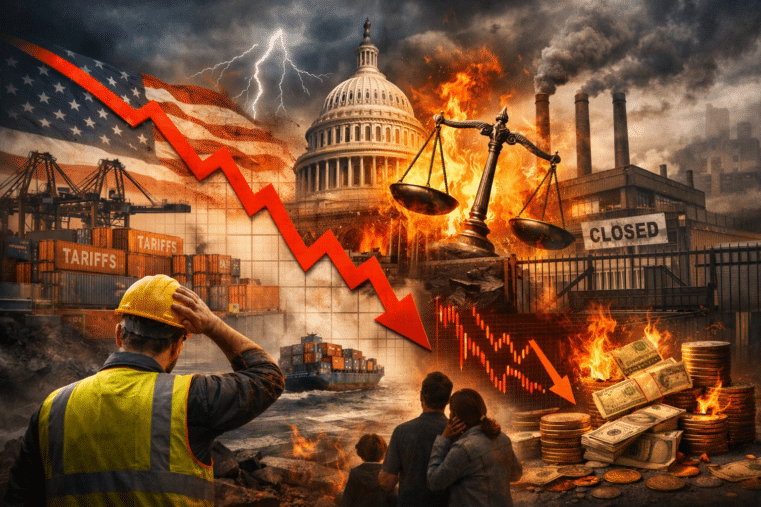
Affordability: Yes, Tariffs Are Taxes
Spanberger criticized Trump’s trade policies, arguing that tariffs function as a tax on American families.
On this narrow point, she’s largely correct.
Tariffs increase costs.
Costs get passed to consumers.
Consumers pay more.
That’s not ideology. That’s economic gravity.
But here’s what’s missing from the rebuttal.
Tariffs are one form of intervention. Democrats frequently support others:
- Industrial subsidies
- Regulatory mandates
- Targeted tax incentives
- Energy market engineering
- Domestic production requirements
Protectionism doesn’t disappear just because it’s branded differently.
If we’re serious about affordability, we can’t pretend tariffs are the only distortion in a heavily managed economy.
The real affordability crisis stems from a system where Washington constantly tweaks, subsidizes, penalizes, and micromanages markets—then acts surprised when prices behave unnaturally.
Inflation: The Conversation Nobody Wants to Finish
We’re told inflation has cooled. That’s fine. But cooling inflation doesn’t mean prices return to previous levels.
Once purchasing power erodes, it rarely rebounds.
And neither party wants to confront the structural drivers behind that erosion:
- Chronic deficit spending
- Expansive federal budgets
- Monetary manipulation
- Emergency spending that never truly ends
Republicans blame regulation.
Democrats blame corporations.
Both avoid a hard look at federal fiscal expansion and central banking policy.
You can’t inflate government and expect stability in prices. The math doesn’t work.
Affordability debates that ignore the size and scope of government are incomplete by design.
Medicaid Cuts and the Dependency Trap
Spanberger criticized proposed Medicaid cuts, arguing they would harm hospitals and vulnerable communities.
There’s truth in that concern.
But here’s the deeper issue: when entire healthcare systems depend on federal funding to survive, we don’t have a decentralized market. We have structural dependency.
That’s not resilience.
That’s fragility.
When institutions rely on federal appropriations, Washington gains leverage over their operations, compliance, and direction.
Republicans argue over spending levels.
Democrats argue over funding priorities.
Neither asks the foundational question:
Why is healthcare so entangled with federal control in the first place?
Dependency isn’t compassion. It’s consolidation.
Immigration Enforcement and Due Process
Spanberger raised concerns about ICE agents using administrative warrants and operating with limited judicial oversight.
If federal enforcement bypasses traditional due process safeguards, that’s serious.
Civil liberties are not partisan privileges. They are structural protections.
But let’s be consistent.
Both parties have expanded executive authority when it suits their priorities.
- Surveillance powers expanded under bipartisan votes.
- Emergency authorities get renewed quietly.
- Administrative agencies gain rulemaking and enforcement reach.
Liberty doesn’t erode in one dramatic sweep. It erodes incrementally—through authority justified as necessary.
If we’re concerned about masked agents and warrants today, we should also be concerned about the broader administrative state that both parties empower when in office.
Power, once granted, rarely contracts.
“Force for Good” — The Bipartisan Assumption
Spanberger accused Trump of weakening America’s global standing.
Republicans accuse Democrats of doing the same.
The disagreement is about tone, not scope.
Both parties assume the United States must maintain expansive global influence.
That assumption requires:
- Massive military budgets
- Broad executive discretion
- Extensive intelligence infrastructure
- Permanent overseas commitments
The debate is not whether Washington should wield enormous power.
It’s who should wield it.
From a libertarian perspective, that’s the wrong argument.
The constitutional framework envisioned a limited federal government. What we have instead is a global manager with domestic reach into nearly every economic sector.
That scale is rarely questioned.
Red vs. Blue Is the Wrong Frame
Spanberger’s rebuttal paints a picture of Republican recklessness.
Republicans paint Democrats as irresponsible spenders.
But zoom out.
Both sides accept:
- A sprawling administrative state
- Chronic deficit spending
- Federal entanglement in healthcare
- Executive enforcement expansion
- Regulatory management of industry
They disagree on emphasis.
They do not disagree on centralization.
That’s the quiet consensus.
And it’s why every election feels existential while government growth remains remarkably consistent.
The Real Affordability Crisis
The affordability crisis isn’t just about grocery bills.
It’s about structural bloat.
When government expands:
- Compliance costs increase
- Regulatory burdens rise
- Market entry becomes harder
- Small businesses get squeezed
- Innovation slows
The result is consolidation.
Consolidation reduces competition.
Reduced competition raises prices.
Then politicians campaign on fixing the consequences of the system they helped build.
It’s a loop.
And neither party is incentivized to break it.
Final Thoughts: Shrink the Machine
Governor Spanberger asked whether the president is working for you.
That’s a valid political challenge.
But here’s the harder truth:
If the federal government has this much control over trade, healthcare, immigration enforcement, fiscal policy, and global intervention—then the deeper problem isn’t which party is in charge.
It’s that the machine is too large.
Affordability doesn’t improve through better management of centralized power.
Safety doesn’t improve through endless expansion of executive authority.
Liberty doesn’t survive when both parties agree that Washington should sit at the center of everything.
Until the size and scope of federal power itself becomes the issue, these rebuttals will remain what they are:
Theater inside an unquestioned framework.
Join the Inner Circle
If you’re tired of surface-level partisan narratives and want serious analysis rooted in constitutional limits, free markets, and individual liberty, it’s time to go deeper.
That’s where we move beyond headlines and dig into the structural forces shaping policy, power, and your freedom—without red-team/blue-team blinders.
If you recognize that the real fight isn’t partisan, but philosophical, you belong inside.
Join us.