The Biggest Credit Bubble in History: Collapse Is Coming

Written by Derek Wolfe
Economist Richard Duncan came up with the term creditism—a system that has nothing to do with the capitalism most of us were raised to believe in. Sure, you still hear the old-timers talking about capitalism like it’s alive and kicking, but Duncan’s here to tell you to wake up. Capitalism died the day the gold standard was buried. In its place? A grotesque system driven by credit, aka debt.
Credit is the lifeblood now. Without it, the whole house of cards comes crashing down. Every single dollar of economic growth is tied to more and more credit expansion. If the credit faucet slows to a trickle, economies don’t just slow—they nosedive into the ground.

So, the Federal Reserve and other central banks have one job: keep the credit flowing. Keep the system on life support. It's why the Fed's got the money spigots cranked wide open. If they dare slow down, the whole thing collapses in on itself.
Duncan doesn't celebrate this reality. He’s just calling it what it is, like a man pointing out that gravity exists or that politicians lie through their teeth. You can rage against it all you want, but this is the hellish system we’re stuck in.
Creditism Is a Drug—and We're Addicted
Since creditism took hold, we’ve seen the wildest booms, the ugliest busts, and chaos on a level we couldn’t have imagined. Every time a bubble bursts, central banks pump in more credit to blow up the next one. And each bubble is bigger, more distorted, and more dangerous than the last. Duncan’s here with some bad news—and trust me, it’s bad.
The Bad News: Welcome to the Apocalypse
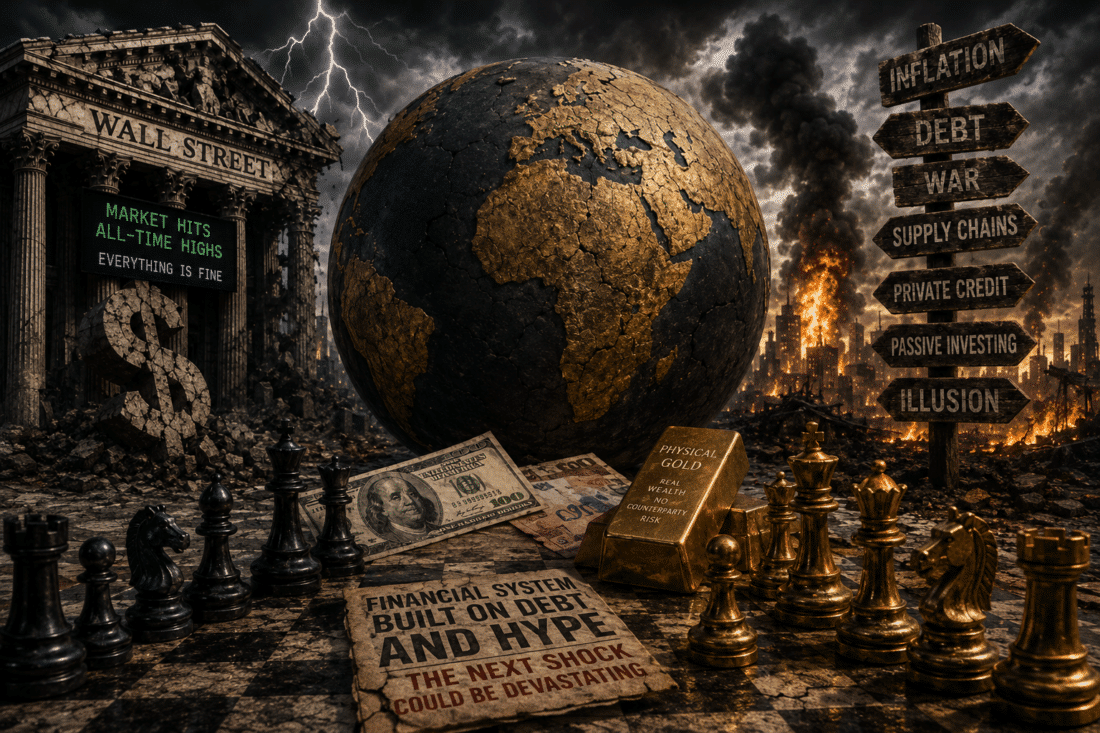
Total credit in the U.S. has hit $100 trillion. That’s right, trillion. A hundred-fold increase in 60 years. What we’re looking at is the biggest credit bubble in human history. And like all bubbles, it’s going to burst. When it does? Kiss civilization goodbye.
When this bubble pops, the resulting economic collapse will make 2008 look like a minor fender bender. The private sector will default on its debts, banks will crumble into dust, and without government intervention, your life savings in the bank will disappear overnight.
Corporations—gone. Small businesses—obliterated. Unemployment will skyrocket to 30%, 40%, maybe even higher. The economy will shrink by half or more. Your pension? Your 401(k)? Worthless. You’ll be lucky if you can find enough cash to buy a loaf of bread.
This won’t just be an economic collapse—it’ll be a societal collapse. Hunger will spark revolutions in the streets. International trade will grind to a halt. Nations will go to war. People will starve. This isn’t some far-off dystopian future—it’s what’s waiting for us if the bubble bursts and the government doesn’t step in.
The "Good" News: More Government Lies
Here’s where it gets twisted. Duncan says the good news is that the government will step in, just like they did in 2008, just like they did in 2020. The system won’t collapse—yet. The central banks will flood the economy with more credit, more fake money, just to keep the beast alive a little longer.
But every time they do this, it’s like giving a junkie another hit. You’re not curing the addiction—you’re feeding it. They’ll keep inflating the bubble, knowing damn well that when it pops, the fallout will be even worse than before. They’ve done it time and again. Every time the markets teeter on the edge, the Fed swoops in with another injection of liquidity, pretending they’re saving the day.
But in reality, they’re only pushing us closer to the final collapse.
An Economy on Life Support
The economy is now like a terminal patient on life support. Every time the central banks intervene, they create new distortions, new imbalances. Remember 2008? That crisis was worse than 2000. And now, today’s distortions are far bigger than what we saw in 2008.
Look at the Federal Reserve’s balance sheet. Back in 2002, it was modest by comparison. Then 2008 happened, and it ballooned. Today? It’s a monstrous, bloated beast, far beyond anything that should exist in a so-called “healthy” economy.
But here’s the thing: everything has its limits. The Fed can’t keep blowing up its balance sheet forever. The laws of economics can only be bent so far before they snap back with a vengeance. You can’t just pump credit into a system indefinitely without facing the consequences.
The Central Banks' Cowardice
What if the Fed had let the market correct itself in 2000? What if they had let the Great Financial Crisis happen in 2008? Maybe, just maybe, we wouldn’t be staring down the barrel of the greatest credit bubble in history right now. But they didn’t have the guts. Instead, they pumped in more credit, blew up a bigger bubble, and kicked the can down the road.
Well, folks, the road’s running out. As Jim Rickards said, each crisis is bigger than the one before because the system itself has grown too big, too distorted. Risk isn’t linear—it’s exponential. The next crisis won’t be another 2008. It’ll be much, much worse.
Intervention Is a Poison
Every time the central banks step in, they make the next crisis inevitable. Their interventions might save the system today, but all they’re doing is setting the stage for the next, even bigger collapse. The problem is that once you start down this path, you can’t turn back. They’ve boxed themselves in. They have to keep inflating or die trying.
But here’s the real kicker: inflate and die is the actual endgame. It’s only a matter of time.
So what can you do? Don’t wait for the system to fail you. Get ready now. Download Seven Steps to Protect Yourself from Bank Failure by Bill Brocius. Take action before this credit bubble bursts and leaves you in the rubble.
Download Now