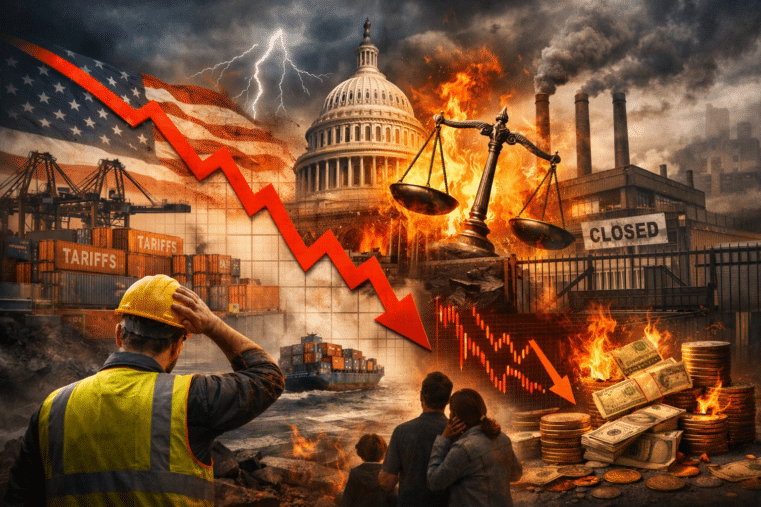

The Great Shift: 2024’s Lessons and 2025’s Challenges

New Year’s Day is a time for reflection, but it’s hard to look back on 2024 without seeing it as a year of seismic shifts. The ground beneath the establishment cracked wide open, exposing the rot of their interventionist, inflationist, and imperialist game plan. Yet, as much as their grip weakened, their resilience shouldn’t be underestimated.
Let’s unpack the chaos of 2024 and the battlefield that awaits in 2025.
2024: The Year the Establishment Stumbled
It’s no secret that power has always been tied to the control of information. For centuries, ruling classes have used their monopolies over information dissemination to solidify their authority. From the priestly elites of the Agrarian Era to the mass-media dynasties of the 20th century, controlling the narrative has been their bread and butter.

But the internet changed everything. Much like the printing press before it, the internet fractured the establishment’s control over the narrative. Suddenly, anyone with a connection could challenge the party line, expose corruption, and rally support for ideas deemed “unacceptable” by those in power.
By 2024, this fracture had widened into a full-blown canyon. Decades of manufactured consent—where the public argued endlessly over minor policy tweaks while the real levers of power remained untouched—collapsed under the weight of unfiltered information.
The result? A global repudiation of establishment incumbents. In the U.S., Trump’s return to the presidency after years of demonization and criminal charges wasn’t just a political win—it was a cultural earthquake. Across demographics, voters rallied behind the anti-establishment banner, rejecting the tired lies of the ruling class.
This wasn’t just an American phenomenon. Around the world, voters ousted establishment politicians, signaling a clear shift: the people are fed up.
2025: The Fight Isn’t Over
But don’t mistake the establishment’s stumbling for surrender. If history has taught us anything, it’s that the ruling class adapts. The internet may have stripped them of their monopoly over information, but they’ve already begun experimenting with new strategies to co-opt, distract, and dilute the anti-establishment momentum.
Take Trump’s 2024 campaign. While his election was a blow to the establishment, hawkish neoconservatives managed to sneak into his inner circle under the guise of an “America First” foreign policy. The appointments of Marco Rubio and Elise Stefanik to key cabinet positions are glaring examples of this co-option. Both are establishment loyalists wrapped in the rhetoric of change, and their appointments reveal a calculated pivot: if you can’t beat the anti-establishment movement, infiltrate it.
This isn’t just limited to Trump. Big tech and legacy media are shifting their focus to informal digital platforms like podcasts, aiming to weaponize these spaces against independent voices. And don’t be surprised if the establishment starts rolling out polished, centralized alternatives to decentralized technologies like Bitcoin to maintain control over the economic narrative.
The Anti-Establishment Coalition: A Fragile Force
While 2024 saw the rise of a powerful anti-establishment coalition, it’s far from unified. Trump’s movement may dominate headlines, but it’s just one part of a broader resistance. Within this coalition are those who see through the smokescreens entirely: people demanding the abolition of the Federal Reserve, an end to America’s endless wars, and the dismantling of the global imperial project.
The challenge in 2025 will be keeping this coalition intact while pushing for real, systemic change. The establishment will do everything it can to sow division, co-opt leadership, and muddy the waters with half-measures disguised as reforms.
A Call to Action
2024 was a test of the establishment’s resilience, and they failed. But 2025 is a test of ours. Will we hold the line, or will we let them claw back the power they’ve lost?
The answer depends on whether we can see through their attempts to rebrand their control as “progress” and stay united in the fight for liberty, sound economics, and a truly independent future.
Remember: the system doesn’t crumble overnight. It took centuries for the printing press to fully reshape the world’s power structures. The internet has only just begun its work. The question is, will we use this tool to build a freer society—or let it be hijacked to serve the same old masters?
The future is unwritten. Let’s make it ours.
Download Bill Brocius’ free eBook, “Seven Steps to Protect Yourself from Bank Failure”, and take the first step toward securing your financial future.
Subscribe to Dedollarize News for the latest insights on how to safeguard your wealth in these turbulent times. Click here to subscribe.