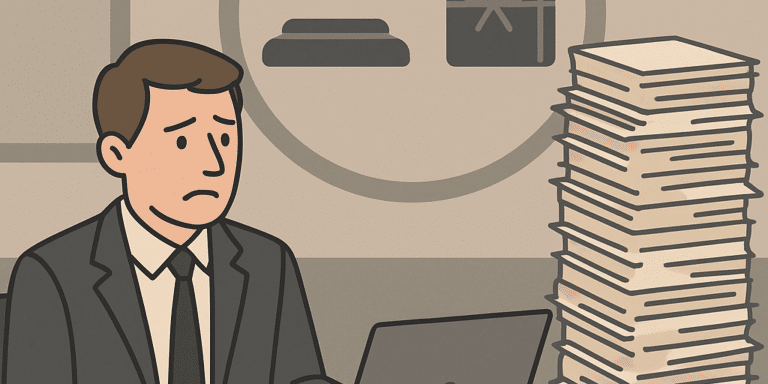
Why Bureaucracy, Not Capitalism, Is the Engine Behind Fake Jobs

The Heart of the Argument: Bureaucracy Breeds Bullsh*t
Sémanne challenges the late David Graeber’s well-known theory that capitalism manufactures “bullsh*t jobs.” While Graeber’s diagnosis of widespread workplace dissatisfaction hit a nerve—many workers do feel their jobs are performative or unnecessary—his explanation stops short of truth. Sémanne proposes a more economically grounded theory rooted in Austrian economics: that state interference in the market, not the market itself, is the real culprit.
Let’s walk through why this interpretation is so important—and what it tells us about where our economy is headed.
1. Regulation Has Replaced Production
The modern labor market is no longer about supply and demand—it's about compliance. Sémanne highlights how every layer of regulation siphons productive effort into box-checking bureaucracy. Hospitals employ more administrators than nurses. Universities are overloaded with DEI officers and regulatory compliance teams. These roles may be filled with hardworking people, but their jobs often exist because of legal mandates, not real-world necessity or value creation.

Mises warned us in Bureaucracy (1944) that once a society trades entrepreneurship for paperwork, the incentives shift from pleasing customers to satisfying procedures. In other words, we’ve built an economy that rewards “doing it by the book,” not “doing it better.”
2. Subsidies and Soft Budgets Distort the Labor Market
In an actual free market, jobs that don't produce value disappear. But when government dollars are on the line, that accountability vanishes. Through subsidies, tax credits, and guaranteed funding, both public and private institutions can afford to employ people in roles that deliver no tangible benefit. It’s a violation of economic gravity: you get jobs with no market value, propped up only by coercion or fiat money.
Mises called this the "calculation problem"—when prices no longer reflect reality, society loses its compass. These fake jobs are the human side of that problem.
3. The Politics of Symbolism Over Substance
One of the sharpest critiques Sémanne makes is the rise of “symbolic labor.” These are roles that exist not to produce value, but to show compliance—with quotas, diversity mandates, ESG guidelines, etc. Workers feel hollowed out because their efforts serve the appearance of virtue rather than genuine output. This mirrors what many of us see in modern corporations: a fixation on narratives, image, and legal cover rather than results.
It’s bureaucracy masquerading as progress.
4. Cheap Money Fuels the Compliance Economy
Central banks have poured trillions into the economy through near-zero interest rates and monetary stimulus. That easy money doesn’t go into productive innovation—it goes into paperwork. Instead of building businesses or making things, graduates become ESG consultants and legal analysts. The credit flows to the safest political projects, not the riskiest innovations.
This is Hayek’s “distortion of the structure of production” playing out in real time: smart people doing meaningless things for institutions that don’t need to turn a profit—because the government foots the bill.
5. Graeber Misunderstood the System
Graeber believed capitalism had gone haywire and was generating make-work to pacify the population. But Sémanne counters that genuine capitalism punishes inefficiency. It’s state-protected, competition-immune sectors where BS jobs thrive. Think of the government employee who didn’t show up for six years and still collected a salary. That’s not capitalism. That’s the absence of capitalism.
Markets are messy, but they self-correct. Bureaucracies just metastasize.
6. Where Fake Jobs Cluster: A Global Glimpse
The article ends with a compelling international comparison: countries like France, with massive public sectors and high government spending, are bloated with administrative work. Places like Switzerland and Singapore—leaner states with freer markets—report higher productivity and job satisfaction. If we want meaning in our work, we need less government, not more.
What Can Be Done: Deregulate Meaninglessness Away
Sémanne’s solution is as bold as it is simple:
- Strip down the legal code.
- End the subsidies.
- Put real budget constraints on public spending.
- Let creative destruction flush out inefficiency.
- Stop central banks from distorting the labor market with artificial credit.
In short: let the market do what it's meant to do—reward value, punish waste, and let people do work that matters.
Final Thought: Why This Article Hits Home
For those watching the economy inflate with jobs that feel hollow and institutions that seem performative, Sémanne offers both a credible diagnosis and a courageous prescription. Bureaucracy—not capitalism—is building a compliance economy where people fake work while pretending to produce. That isn’t progress; it’s decay dressed in a suit.
The only way forward is through decentralization, real risk, and real value creation. Let the market work, and work will mean something again.
Take Action Before the Next Wave Hits
If you're concerned about what this trend means for your financial future, I highly recommend reading Bill Brocius’ book, End of Banking As You Know It, and subscribing to his Inner Circle newsletter for $19.95/month. Bill’s no-nonsense insights cut through the noise and help everyday people prepare for systemic breakdowns the mainstream media won’t warn you about.
And if you haven’t yet, download our free guide:
👉 7 Steps to Protect Your Account from Bank Failure
This is not the time to trust the system. It’s the time to understand it—and sidestep it.
—Eric Blair,
Dedollarize News