“A Shortage of Nearly Everything” Is Already Here — Global Supply Chains Are Cracking Faster Than Anyone Admits

The Shortages Aren’t Coming — They’ve Already Started
The narrative being pushed is that shortages might happen.
That’s false.
They’re already unfolding in real time—you just haven’t felt the full force of it yet.

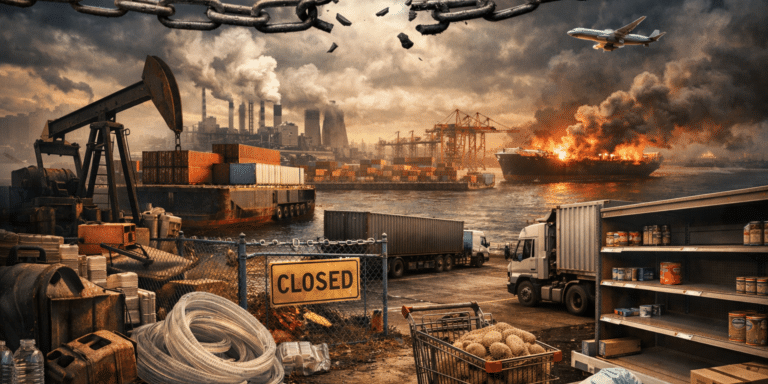
Within just over a month of escalating conflict in the Middle East, cracks in the global supply chain are no longer theoretical. They’re visible, measurable, and accelerating. When even mainstream outlets start using phrases like “a shortage of nearly everything,” you know the situation has moved beyond speculation.
This isn’t panic. This is pattern recognition.
It Starts With Oil — But It Never Ends There
Every modern supply chain begins with energy.
Disrupt oil, and you don’t just affect gasoline—you destabilize everything built on top of it. That includes:
- Plastics
- Packaging
- Transportation
- Agriculture
- Manufacturing
And right now, one of the most critical choke points in the world—the Strait of Hormuz—is under threat of long-term disruption.
That matters more than most people understand.
Because when oil flows become restricted, the ripple effect moves fast—and it compounds.
Plastic Is the First Domino to Fall
Here’s where things get uncomfortable.
We don’t just run on oil—we run on its byproducts.
Plastic is everywhere. And when petroleum supply tightens, plastic production gets hit almost immediately.
We’re already seeing:
- Manufacturers in Taiwan running out of plastic
- South Korea experiencing panic-buying of trash bags
- Governments urging reduced use of disposable materials
- Medical supply chains under strain due to lack of plastic components
Think about that for a second.
Trash bags. Medical tubing. Food packaging.
These are not luxuries. These are baseline necessities of modern life.
And they’re starting to get scarce.

The Hidden Chain Reaction Most People Miss
When plastic becomes scarce, it doesn’t just affect obvious items.
It quietly disrupts entire industries:
- Food packaging shortages → food waste and price spikes
- Medical supply constraints → reduced treatment capacity
- Manufacturing slowdowns → fewer goods, higher prices
- Shipping delays → empty shelves
Even everyday items like:
- Shoes
- Furniture
- Cosmetics
- Snacks
…all rely on petroleum derivatives somewhere in their production.
That’s why experts are warning this spills into “everything.”
And they’re not exaggerating.
Diesel Prices Are the Real Warning Signal
If you want to understand where this is going, don’t watch headlines—watch diesel.
Diesel is the backbone of:
- Farming equipment
- Freight transport
- Industrial production
And it’s already surging at a pace that should concern anyone paying attention.
In just one month:
- Diesel prices have jumped dramatically nationwide
- In some areas, they’ve nearly doubled
- California is already seeing record-breaking levels
That matters because diesel costs don’t stay isolated—they get passed down the chain.
Every product you buy has a diesel cost baked into it.
When diesel spikes, everything follows.
Transportation Is Beginning to Break Down
Now layer in aviation fuel shortages.
Jet fuel prices have surged sharply in a matter of weeks, and supply is tightening globally.
The consequences are already showing up:
- Flights being canceled across Asia
- Airlines cutting routes
- European carriers preparing for large-scale disruptions
Air travel is one of the first sectors to visibly crack under fuel pressure—but it won’t be the last.
Shipping lanes, trucking networks, and logistics systems are all next in line.
The Illusion of “Temporary” Is Dangerous
There’s still a widespread belief that once the conflict ends, everything will revert back.
That’s not how this works.
Energy infrastructure has already been damaged. Supply chains have already been disrupted. Pricing structures have already shifted.
Even if stability returned tomorrow, the system wouldn’t simply reset.
Once shortages begin cascading through interconnected systems, recovery becomes slow, uneven, and often incomplete.
That’s the part people underestimate.
What Happens If This Continues?
If current conditions persist, here’s what becomes increasingly likely:
- Sustained increases in food prices
- Reduced availability of essential goods
- Medical supply constraints
- Transportation bottlenecks
- Long-term inflation across multiple sectors
Not overnight collapse—but steady, grinding pressure.
The kind that erodes stability piece by piece.
My Take: This Is a Systems Stress Test — And It’s Not Passing
I’ve spent years watching how fragile these interconnected systems really are.
What we’re seeing now is a real-world stress test—and the system is already showing signs of strain.
The problem isn’t just the war.
It’s how tightly everything is coupled:
- Energy → Manufacturing → Logistics → Retail
Disrupt one node hard enough, and the entire chain starts to wobble.
Right now, multiple nodes are under pressure simultaneously.
That’s not a normal situation.
What You Should Be Paying Attention To
Forget the noise. Watch these signals:
- Diesel prices
- Availability of basic materials (especially plastics)
- Flight cancellations and shipping delays
- Food packaging and distribution issues
These are early indicators—not headlines, but warning lights.
And they’re already blinking.
Final Thought: Complacency Is the Real Risk
The biggest danger right now isn’t panic.
It’s indifference.
Most people assume someone, somewhere, has this under control.
But systems like this don’t fail all at once—they degrade gradually, then suddenly.
We’re still in the gradual phase.
But the shift toward “suddenly” can happen faster than most expect.
Take Action Before the Window Closes
If you’re starting to see the bigger picture, don’t stop at understanding the problem.
The financial system is evolving alongside these disruptions—and not in a way that favors individual control. Systems like FedNow, the rise of central bank digital currencies (CBDCs), and the push toward programmable money are setting the stage for a level of financial surveillance and restriction most people aren’t prepared for.
That’s why getting ahead of this matters.
Download the Digital Dollar Reset Guide by Bill Brocius—it lays out exactly what’s happening, what’s coming next, and how to position yourself before control tightens.
This isn’t optional reading. It’s preparation.