China’s Gold Power Play: The Silent Monetary Shift That Could Undermine the U.S. Economy

The Gold Rush That Isn’t About Jewelry
Let’s cut through the noise.
China didn’t just “find gold.” It secured leverage.
We’re talking about thousands of tons of newly confirmed deposits—Wangu, Dadonggou, offshore Shandong—stacked on top of 17 straight months of central bank gold buying. That’s not coincidence. That’s strategy.

Gold, unlike fiat currency, doesn’t depend on trust in a government. It doesn’t require a counterparty. It can’t be printed, frozen, or politically weaponized overnight.
And right now, China is hoarding it like a nation preparing for a financial storm.
A Strategic Pivot Away From the Dollar
The real story isn’t the gold itself—it’s what China is moving away from.
For decades, the U.S. dollar has been the backbone of global trade and reserves. That dominance gave Washington enormous power: sanctions, asset freezes, monetary influence.
Then 2022 happened.
When the West froze roughly $300 billion in Russian assets, it sent a shockwave through central banks worldwide. The message was clear: if you’re not aligned politically, your reserves aren’t safe.
China took that personally—and acted accordingly.
- U.S. Treasury holdings: slashed nearly in half
- Gold reserves: aggressively expanded
- Domestic production: prioritized and absorbed internally
This isn’t diversification. It’s detachment.
BRICS Is Building a Parallel System
China isn’t alone.
Across the BRICS bloc, central banks are quietly stacking gold at a pace that would’ve seemed extreme just five years ago. Together, they now hold over 6,000 tons, representing a growing share of global reserves.
But here’s where it gets interesting.
They’re not just hoarding—they’re experimenting.
A gold-influenced settlement mechanism—reportedly blending gold with local currencies—is already being tested in cross-border systems. That means trade could increasingly happen outside the dollar framework.
No SWIFT dependency.
No dollar clearing.
No U.S. oversight.
That’s not evolution. That’s replacement infrastructure.
Why This Matters for the U.S. Economy
Let’s talk consequences—because this isn’t abstract.
Declining Demand for U.S. Debt
The dollar’s dominance relies heavily on global demand for U.S. Treasuries. When countries stockpile dollars, they’re effectively financing U.S. spending.
But if major economies start shifting into gold and alternative systems?
Demand drops.
And when demand drops:
- Borrowing costs rise
- Debt becomes harder to sustain
- Monetary policy loses flexibility
That’s a dangerous feedback loop for an already debt-heavy system.
Reduced Global Influence
Financial dominance has always been America’s silent weapon.
Sanctions work because the dollar system is unavoidable. But if BRICS nations—and others—create viable alternatives, that leverage erodes.
You can’t control a system you don’t dominate.
A Fragmented Global Economy
We’re watching the early stages of a split:
- Dollar-based system (West)
- Commodity/gold-influenced system (BRICS+)
That fragmentation introduces inefficiencies, volatility, and geopolitical tension. Trade becomes more complex. Currency risk increases. Alliances harden.
This isn’t globalization—it’s financial tribalism.
China’s Endgame: Control Without Exposure
Here’s the part most analysts won’t say out loud.
China’s strategy is about minimizing vulnerability while maximizing optionality.
By increasing domestic gold supply and absorbing it internally, they:
- Reduce reliance on external markets
- Shield reserves from foreign interference
- Build a hard-asset foundation for future monetary moves
It’s a long game.
And while the U.S. continues operating inside a debt-driven, consumption-heavy model, China is quietly reinforcing its position with tangible assets.
The Bigger Picture: A Structural Reset in Motion
This isn’t a temporary shift.
This is what systemic change looks like before it becomes obvious.
- Gold is being repriced—not just in value, but in importance
- The dollar is slowly losing exclusivity
- Alternative systems are being tested in real time
Most people won’t notice until the effects hit closer to home—through inflation, market instability, or reduced purchasing power.
By then, the groundwork will already be laid.
Final Thoughts: Pay Attention to What They’re Not Saying
Mainstream coverage will frame this as routine diversification.
It’s not.
This is a coordinated shift in how nations store value, settle trade, and protect themselves from geopolitical risk.
And the U.S.—for the first time in decades—is not at the center of that shift.
Ignore that at your own risk.
Take Action Before the System Shifts Further
If you’re starting to see the pattern—central banks stacking gold, global alliances moving away from the dollar, and new financial systems forming behind the scenes—then you already understand this isn’t something to watch passively.
It’s something to prepare for.
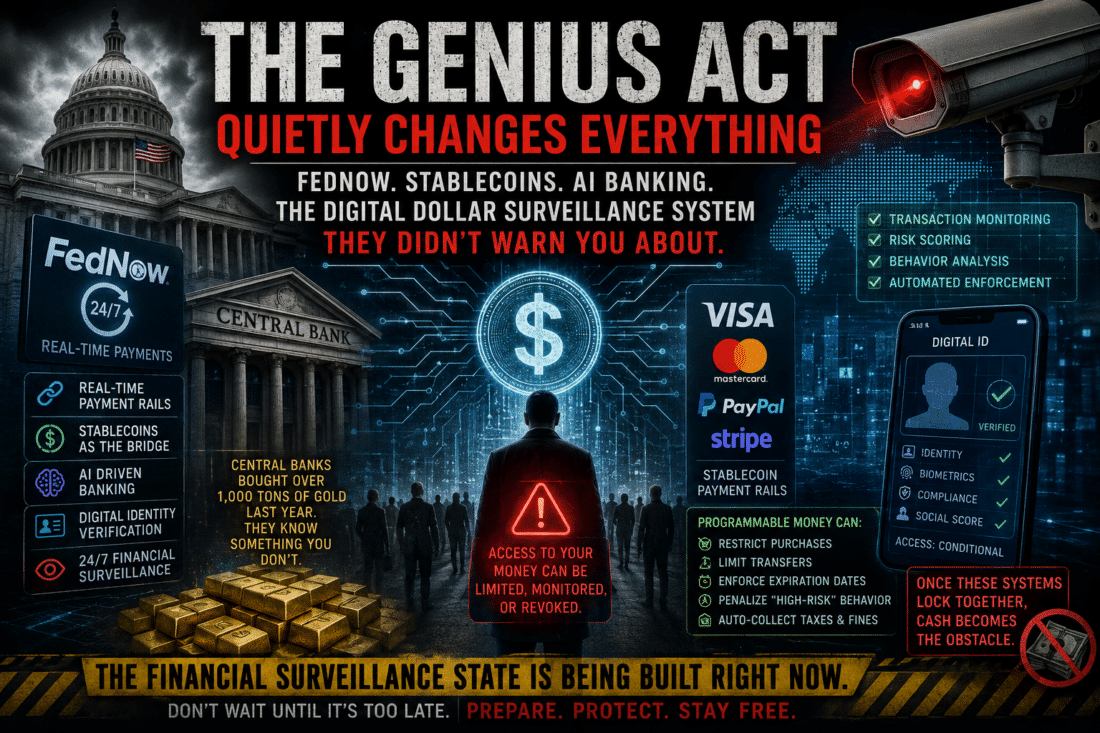
The next phase isn’t just about gold—it’s about digital control layers being built on top of the financial system, including technologies like FedNow, central bank digital currencies (CBDCs), and programmable money.
That’s where things get real.
If you want a clear breakdown of what’s coming—and how to protect your financial autonomy—you need to get your hands on the Digital Dollar Reset Guide by Bill Brocius.
This isn’t optional reading. It’s strategic intelligence.
Because once these systems are fully in place, reacting will be too late.