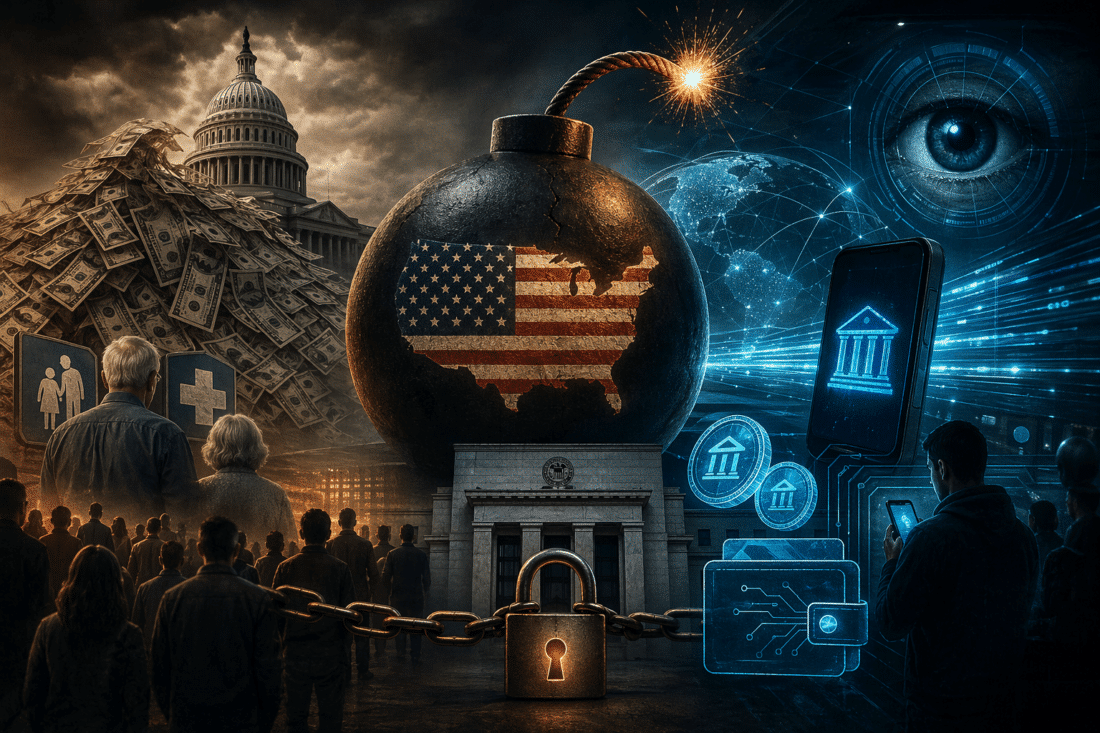
Digital Dollar Shock: Washington is Quietly Building a Financial Surveillance Grid

The Distraction Playbook Is Back
History doesn’t repeat—it refines its methods.
In 1971, Nixon severed the dollar from gold under the cover of economic “emergency.” Most people didn’t grasp it at the time. They were too busy reacting to wage and price controls—loud, visible, and temporary. The real shift? Permanent.
Fast forward to now. While the public watches missiles and media narratives, the financial system is undergoing another structural rewrite. Quiet. Technical. Buried in policy language.

But make no mistake—this one cuts deeper.
The Rise of Programmable Money
Let’s strip away the jargon.
Recent moves by the U.S. Treasury, FinCEN, and OFAC aim to fold stablecoins directly into the Bank Secrecy Act framework. On paper, it’s about “security” and “innovation.” In practice, it’s about visibility—and control.
This is where the concept of programmable money stops being theoretical.
Imagine money that isn’t just exchanged—but instructed.
- Funds that can only be spent on approved categories
- Transactions that trigger automatic reporting or restrictions
- Accounts flagged or frozen without traditional due process
This isn’t speculation—it’s the natural endpoint of combining digital currency infrastructure with regulatory oversight and algorithmic enforcement.
FedNow and the CBDC Foundation
The FedNow payment system is often marketed as a convenience upgrade—instant payments, 24/7 access, streamlined transfers.
That’s true. But it’s also incomplete.
FedNow is infrastructure. It lays the rails. What runs on those rails is where things get serious.
Globally, central banks are advancing Central Bank Digital Currency (CBDC) initiatives. The U.S. has been more cautious in branding, but not in capability-building. Stablecoins regulated under federal frameworks begin to mirror many CBDC characteristics:
- Centralized visibility
- Compliance-enforced transactions
- Integration with existing banking systems
The difference between a “regulated stablecoin” and a “CBDC” starts to blur fast when both operate under the same surveillance and control architecture.
Financial Surveillance Is No Longer Fragmented
For years, financial oversight came in layers:
- Know Your Customer (KYC) rules
- Suspicious Activity Reports (SARs)
- Anti-Money Laundering (AML) compliance
Each added friction—but also distance.
Now, those layers are consolidating.
When transactions become fully digital, fully traceable, and increasingly automated, surveillance stops being reactive and becomes real-time and predictive.
You’re not just monitored after the fact—the system can intervene as it happens.
That’s a fundamental shift.
When Access Becomes Conditional
Here’s where it stops being abstract.
We’ve already seen examples globally of individuals being cut off from financial systems due to sanctions, political positioning, or regulatory decisions. Whether justified or controversial isn’t the point.
The mechanism exists.
When money is digitized and centrally governed, access can be:
- Restricted
- Delayed
- Denied
And if programmable rules are applied, spending itself can be shaped.
This introduces a new reality: money that doesn’t just belong to you—it’s permissioned to you.
The Global Reaction: Moving Away from Dollar Dependence
Other nations are watching closely.
When access to dollar-based systems like SWIFT can be revoked, countries begin exploring alternatives. We’re seeing increased interest in:
- Bilateral trade in local currencies
- Gold accumulation by central banks
- Independent payment systems
This isn’t ideology—it’s risk management.
If financial access can be weaponized, diversification becomes survival.
My Take: This Isn’t About Convenience
You’ll hear the pitch framed around efficiency, modernization, and innovation.
And yes—those elements are real.
But they’re not the full picture.
As someone who’s spent decades around systems, code, and the ways power embeds itself into infrastructure, I’ll tell you this: control is always baked into design.
Programmable money isn’t just a feature—it’s a capability.
And once that capability exists, it will be used.
Not always maliciously. Not always broadly. But selectively, strategically, and—over time—systematically.
The Line Between Money and Control Is Disappearing
Cash had a defining trait: finality.
If you had it, you could use it. No intermediary. No override.
Digital systems change that.
They introduce:
- Intermediaries
- Permissions
- Conditions
And eventually—rules that operate without human interaction.
When AI and automated compliance systems enter the equation, decisions about your financial access may no longer be transparent—or even explainable.
That’s not a conspiracy. That’s how complex systems behave at scale.
Where This Is Heading
We’re moving toward a financial environment where:
- Transactions are continuously monitored
- Behavior can be influenced through financial incentives or restrictions
- Access to money can be dynamically adjusted
Some will welcome it—for security, for order, for efficiency.
Others will recognize the tradeoff.
Either way, the shift is happening.
What You Do With This Information Matters
You don’t need panic. You need awareness.
The worst position to be in is caught off guard—assuming the system still works the way it used to.
It doesn’t.
And it won’t.
If you’re paying attention, you already see the pattern forming: centralized control, digital enforcement, and the gradual erosion of financial autonomy under the banner of progress.
The Move You Make Now Matters
If you’re seeing the writing on the wall—the rise of FedNow, the push toward a central bank digital currency (CBDC), the expansion of financial surveillance, and the reality of programmable money—then sitting on the sidelines isn’t a strategy.
This is where preparation separates awareness from action.
The shift toward a digital dollar system isn’t theoretical anymore. It’s being built, piece by piece, under regulatory frameworks most people will never read. And once it’s fully operational, your ability to control your own money—how you earn it, store it, and spend it—could look very different.
That’s why getting educated right now isn’t optional.
It’s critical.
Download the Digital Dollar Reset Guide by Bill Brocius and understand exactly what’s coming—and more importantly, what you can do about it.
This isn’t hype. It’s a survival playbook for navigating:
- The FedNow payment system
- The rollout of CBDCs
- The expansion of government financial surveillance
- The risks of programmable, controlled currency
If you wait until the system is fully in place, your options shrink fast.
Get ahead of it while you still can.
Because once your money comes with rules you didn’t agree to…
it’s already too late to negotiate.