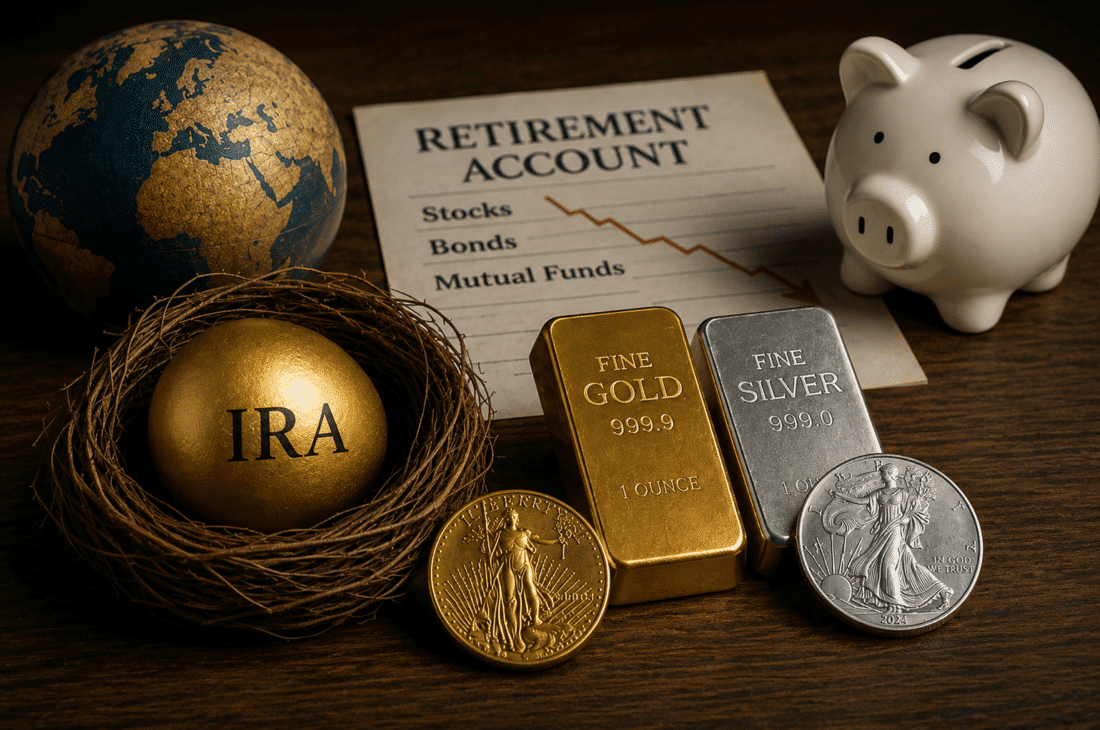
Gold vs. Wall Street: Why America First Investors Are Choosing Real Money Over Financial Fantasy

America Is Facing a Debt Problem Washington Doesn't Want to Discuss
There are many problems in America today.
But one problem sits above them all.
Debt.

The federal government has accumulated nearly $40 trillion in debt, fueling the national debt gold narrative as more investors seek assets insulated from Washington's borrowing spree.
Every year, Washington spends money it does not have.
Every year, politicians promise more programs, more spending, and more borrowing.
Every year, the bill grows larger.
The problem is no longer theoretical.
It is mathematical.
And math eventually wins.
For years, America benefited from being the issuer of the world's reserve currency. That privilege allowed Washington to borrow at extraordinarily favorable rates.
But investors around the world are beginning to ask a simple question:
How much debt is too much debt?
The answer may be approaching faster than policymakers would like to admit.
Why Rising Treasury Yields Matter to Every American
Most Americans never pay attention to bond markets.
They should.
The global bond market is larger than the stock market.
And right now, it is sending a message.
Government borrowing costs are rising.
When Treasury yields increase, it means investors are demanding more compensation to lend money.
In simple terms, lenders perceive greater risk.
That matters because higher borrowing costs create a vicious cycle.
More debt leads to higher interest expenses.
Higher interest expenses require more borrowing.
More borrowing creates more debt.
The cycle feeds itself.
Eventually, governments face difficult choices.
Raise taxes.
Cut spending.
Or create more currency.
History suggests politicians often choose the third option.
The America First Case for Sound Money
The Founders understood the dangers of currency debasement.
They understood that governments throughout history have repeatedly resorted to inflation whenever debts became unmanageable.
Inflation acts as a hidden tax.
It quietly reduces purchasing power.
It punishes savers.
It rewards debtors.
And it allows governments to pay yesterday's obligations with tomorrow's weaker dollars.
That is why many America First investors increasingly embrace the national debt gold strategy, viewing gold as financial protection rather than a conventional investment.
They view it as financial self-defense.
Gold cannot be printed.
Gold cannot be created with a keystroke.
Gold does not depend on a politician's promise.
Gold simply exists.
And for thousands of years, it has preserved purchasing power through wars, monetary crises, and government failures.
Foreign Buyers Are Slowly Rethinking U.S. Debt
Another trend deserves attention.
Many foreign governments are reducing their exposure to U.S. Treasuries.
China's Treasury holdings have fallen significantly from previous highs.
Other nations are diversifying reserves.
Central banks around the world have been accumulating gold at some of the fastest rates in decades, reinforcing the national debt gold argument as governments and institutions prepare for mounting fiscal risks.
That is not happening by accident.
Central bankers may disagree on many things.
But they understand risk.
And many appear to be reducing reliance on paper assets while increasing exposure to hard assets.
Investors should ask themselves why.
Wall Street Wants You Chasing Stocks
Wall Street has a predictable business model.
Keep money flowing into financial products.
Keep investors fully invested.
Keep assets under management growing.
Today, many market valuations remain historically elevated.
Yet investors continue pouring money into a relatively small number of large-cap stocks.
The concentration risk is significant.
The optimism is remarkable.
And the underlying economic fundamentals are becoming increasingly difficult to ignore.
Consumer debt remains elevated.
Credit card delinquencies are rising.
Government deficits remain massive.
Yet stock market enthusiasm continues.
History suggests this combination does not last forever.
Gold Isn't Competing Against Stocks
This is where many investors get confused.
Gold is not necessarily competing against stocks.
Gold is competing against currency debasement.
That distinction matters.
Stocks may rise.
Gold may rise.
Both can happen simultaneously.
The real question is whether the purchasing power of the dollar continues declining over time.
Many Americans already know the answer.
They see it at the grocery store.
They see it at the gas pump.
They see it in housing costs.
They see it in insurance premiums.
The dollar buys less than it did years ago.
That trend has not disappeared.
Why Central Banks Keep Buying Gold
One of the most overlooked stories in global finance is central bank gold accumulation.
For years, central banks have been adding gold to their reserves.
Not cryptocurrencies.
Not tech stocks.
Gold.
Why?
Because gold carries no counterparty risk.
It is not someone else's liability.
It does not depend upon repayment.
It does not require trust in another institution.
In a world increasingly defined by geopolitical uncertainty, debt expansion, and financial instability, those qualities matter.
A lot.
Inflation May Be Far From Finished
Many Americans hoped inflation would disappear after the initial surge.
Instead, prices remain elevated across large segments of the economy.
Energy.
Food.
Insurance.
Housing.
Healthcare.
The reality is simple.
Inflation is not merely a temporary event.
It is often the consequence of long-term monetary and fiscal decisions.
When governments spend beyond their means year after year, inflationary pressures eventually emerge.
Sometimes slowly.
Sometimes suddenly.
But the laws of economics cannot be repealed.
Gold and Economic Freedom
The Austrian School of Economics has long warned about the consequences of excessive debt, central bank intervention, and artificial credit expansion.
Many of those warnings are now becoming visible.
Markets increasingly depend on policy support.
Debt levels continue reaching new records.
Currency purchasing power continues facing pressure.
Gold offers something different.
It exists outside the political system.
Outside central bank balance sheets.
Outside election cycles.
Outside Washington's promises.
That independence is precisely why many investors continue viewing gold as an essential component of long-term wealth preservation.
Why Gold Remains an America First Asset
An America First approach starts with protecting American families.
Protecting savings.
Protecting purchasing power.
Protecting financial independence.
Gold aligns with those objectives.
It does not require trust in bureaucrats.
It does not depend on foreign creditors.
It does not rely on endless debt expansion.
It represents tangible wealth in a world increasingly built on financial engineering.
That is why gold has survived every currency experiment in recorded history.
Governments come and go.
Currencies rise and fall.
Gold remains.
The Bottom Line: Real Money in an Age of Debt
America stands at an economic crossroads.
Debt is rising.
Deficits are growing.
Confidence in institutions is weakening.
And the solutions offered by Washington often involve more borrowing, more spending, and more monetary expansion.
Many investors continue chasing the latest market trend.
Others are taking a different path.
They are focusing on preserving wealth rather than maximizing speculation.
They are studying history instead of headlines.
And they are recognizing a simple truth that has endured for thousands of years:
When governments accumulate too much debt and currencies lose purchasing power, hard assets matter.
Gold is not popular because of fear.
Gold is popular because of history.
And history has a habit of repeating itself.
Join the DeDollarize News Inner Circle
Want deeper analysis on gold, silver, inflation, central banking, economic freedom, government debt, and the financial forces reshaping America?
The DeDollarize News Inner Circle provides exclusive research, market insights, special reports, and actionable intelligence designed to help Americans protect and grow their wealth in uncertain times.
Subscribe Here with this Special Offer: Join today for just $19.95 per month (normally $39.95).