The Russell 2000 Scam: How 42% of Your Retirement Fund Could Vaporize in the Next Crash

The Illusion of Safety in Small Caps
The Russell 2000 is marketed as the premier gateway to American small-cap stocks. It’s embedded in retirement accounts, ETFs, and target-date funds. Fund managers treat it as gospel. But peel back the layers, and you’ll find a model so flawed, so recklessly structured, that it has become a systemic risk masquerading as a growth vehicle.
Small caps are supposed to be the nimble, high-potential engines of American enterprise. But when 42% of them are bleeding money, the narrative begins to crack—and what’s left is a financial illusion engineered for complacency, not performance.
The Deception Behind the Numbers
Wall Street proudly displays the Russell 2000’s price-to-earnings (P/E) ratio at a seemingly reasonable 19. But dig a little deeper—read the fine print—and you’ll see the truth: that number excludes all companies losing money.

That’s not a footnote. It’s a lie by omission.
When nearly half of the companies in an index are unprofitable, the honest P/E ratio balloons to a staggering 36. That’s not just overvalued—it’s dangerously inflated. And when markets tighten or credit dries up, unprofitable companies are the first to collapse.
A Glut of Unprofitable IPOs
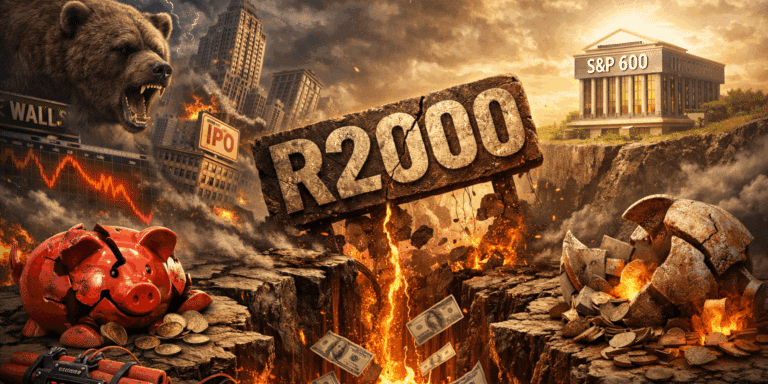
The index is further corrupted by a flood of recent IPOs—nearly 70% of which are losing money. These aren’t just bad bets; they’re embedded landmines. Wall Street knows it. So they bury them in indexes, dilute the risk, and sell you the illusion of diversification.
But when systemic stress returns, these weak links snap. And with nearly half the Russell 2000 made up of corporate dead weight, this index will not bend—it will break.
The Better Alternative Wall Street Ignores
There is a small-cap index that filters out the rot: the S&P 600. It includes only companies that are profitable and continually reviews its components to ensure they remain so. It’s everything the Russell 2000 pretends to be—transparent, disciplined, and aligned with real economic performance.
It even outperforms. Over the past five years, the S&P 600 delivered 11.4% annual returns, compared to 9.75% from the Russell 2000. And yet, most investors have never even heard of it. Why? Because Wall Street isn’t in the business of protecting your wealth—it’s in the business of selling products.
Why This Matters Now
In stable times, flawed models limp along unnoticed. But we are not in stable times.
Rising debt, inflation manipulation, shrinking real yields, and creeping digital financial control all point to a looming reset. When the next crash hits—and it will—investors locked into indexes like the Russell 2000 will see their savings vaporize while Wall Street pivots and profits.
The financial elite have built an ecosystem of structured deception—and retail investors are the liquidity exit. Your retirement account is not diversified. It’s loaded with liabilities wearing blue-chip costumes.
The Hard Truth: You're Not Safe
The Russell 2000 isn’t an index. It’s a trap. It’s a container for unprofitable, overhyped companies that are marketed as “safe exposure to small caps.” But in reality, it's a ticking time bomb of artificially sustained valuations and dying companies that can’t weather a storm.
If you're holding ETFs like IWM, you're holding a mirage. You're trusting a system that already lied to you about its fundamentals—and will lie again when the collapse comes.
That’s why you need to prepare now.
👉 Download the Digital Dollar Reset Guide and get the strategies the elites hope you never discover. Inside, you’ll find how to protect your assets, diversify beyond Wall Street’s broken system, and position yourself for the seismic shifts already underway.
Time is short. Ignorance is expensive. Don’t wait for the next crash to find out what your portfolio is really worth.
This isn’t about switching one ETF for another. This is about understanding that the traditional banking and investment system is no longer built for your survival. It’s built for your obedience. It’s built to keep you in until the trapdoor opens.