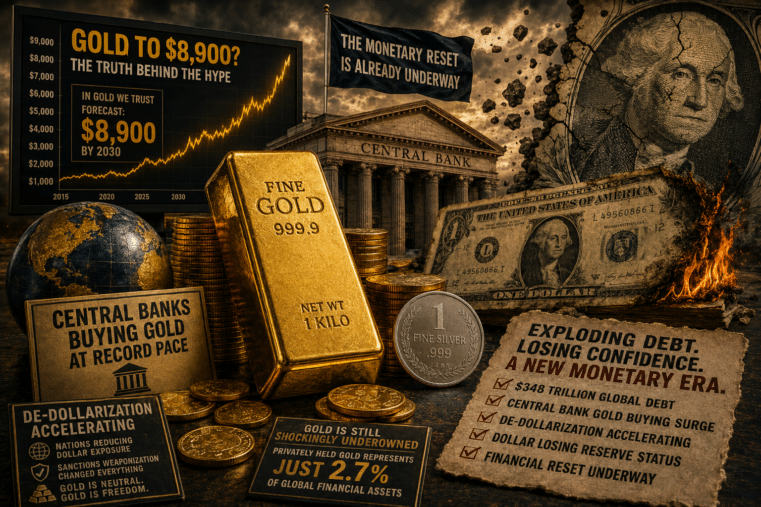
Digital Dollar Warning: Gold Stalls as Fed Policy, CBDC Threats, and Financial Surveillance Risks Intensify

Gold Is Stuck—But That’s Not the Real Story
At first glance, gold holding between $4,700 and $4,800 an ounce looks like a market catching its breath. But as any seasoned trader knows, stagnation during periods of geopolitical chaos and inflation pressure is not a sign of strength—it’s a warning.
Despite ongoing conflict in the Middle East and rising oil prices fueling inflation fears, gold has failed to break higher. Instead, it’s drifting sideways, capped below key resistance. That’s not because the risks have disappeared. It’s because the monetary system is shifting beneath it.
And that shift is being driven by central banks.

Central Banks Are Cornered—and That’s Bad for You
The Federal Reserve and its global counterparts—the Bank of Japan, ECB, Bank of England, and Bank of Canada—are all facing the same problem: inflation refuses to die, and the cost of controlling it is economic pain.
Markets are now dialing back expectations for rate cuts. Just weeks ago, investors were betting on easing. Now? Less than a 40% chance by year-end.
Why does that matter?
Because higher-for-longer interest rates strengthen fiat currencies in the short term, suppress gold, and—more importantly—tighten financial conditions for everyday people. This is the classic playbook of financial repression.
But here’s what most analysts won’t say outright: central banks are losing control of the system they built.
Inflation Isn’t Going Away—It’s Being Engineered
Rising oil prices tied to geopolitical tensions are already feeding into consumer prices. Upcoming GDP and PCE data will likely confirm what many households already feel—purchasing power is eroding.
Historically, this is where gold should surge.

But today’s environment is different. Why?
Because central banks are no longer just managing interest rates. They’re preparing to control the entire monetary system through digital infrastructure.
FedNow, CBDCs, and the Rise of Programmable Money
While markets obsess over whether the Fed will cut or hike, a far more consequential development is unfolding in the background: the expansion of the FedNow payment system and the global push toward central bank digital currencies (CBDCs).
This isn’t theory. It’s policy in motion.
CBDCs introduce programmable money—currency that can be tracked, restricted, and even expired. Combined with real-time settlement systems like FedNow, this creates the architecture for full-spectrum financial surveillance.
Every transaction monitored. Every dollar controlled.
And once that system is in place, traditional safe havens like gold become less about price speculation—and more about financial escape routes.
Gold’s Short-Term Weakness, Long-Term Signal
Technically, gold is showing cracks. It’s struggling below resistance, breaking below key moving averages, and at risk of retesting lower levels around $4,600 or even $4,450.
But focusing only on short-term price action misses the bigger picture.
The underlying drivers supporting gold haven’t disappeared—they’ve intensified:
- Exploding government debt
- Persistent inflation
- Geopolitical instability
- Eroding trust in central banks
These are not temporary conditions. They are structural.
And historically, structural crises don’t resolve quietly.
The Debt Bomb Nobody Can Ignore
One of the most overlooked factors in the current landscape is the trajectory of U.S. public finances.
Mounting debt, driven by military spending and fiscal expansion, is pushing the system toward a breaking point. Central banks are trapped—they can’t raise rates indefinitely without triggering a debt crisis, and they can’t cut without fueling inflation.
This is the endgame of fiat currency cycles.
And it’s precisely why digital currencies are being positioned as the “solution.”
This Isn’t About Gold—It’s About Control
If you’re only watching gold prices, you’re missing the real story.
The consolidation in gold reflects a market waiting for clarity. But the system itself is moving toward something far more controlled, far more centralized, and far less forgiving for those who aren’t prepared.
Financial autonomy is being quietly eroded.
Cash is being sidelined. Transactions are becoming traceable. And the tools for enforcing compliance are being built in real time.
What You Do Now Matters
History doesn’t repeat exactly—but it rhymes. From the collapse of Bretton Woods to the inflation crisis of the 1970s, moments like this mark turning points in monetary systems.
The difference today is the level of control technology enables.
You are not just facing inflation. You are facing the digitization of money itself—and all the restrictions that come with it.
That means the strategy must go beyond watching markets. It requires preparation.
Final Word: Act Before the Window Closes
The warning signs are all here:
- Central banks tightening policy amid inflation
- Gold struggling under artificial pressure
- Digital payment systems expanding rapidly
- Governments laying the groundwork for CBDCs
This is not a distant threat. It’s unfolding now.
If you wait until the system fully transitions, your options may already be limited.
Bill Brocius has been ahead of this curve for years. His Digital Dollar Reset Guide lays out exactly what’s coming—and, more importantly, how to protect yourself before financial control becomes the new normal.
Download it now while access is still unrestricted.
Because once programmable money is fully deployed, reacting won’t be enough.
You’ll need to have already moved.