THE PENTAGON, AI, AND YOU: WHEN “CLASSIFIED” MEETS CONSTITUTIONAL RIGHTS

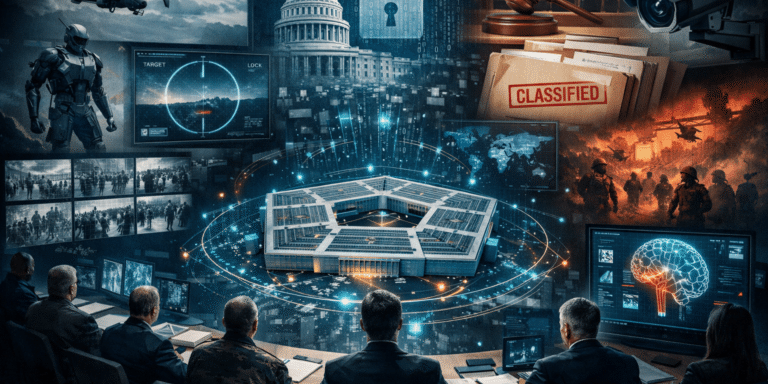
AI Has Entered the War Room
Let’s be clear.
Advanced AI systems are now being deployed across Department of Defense networks — including classified ones.
The CEO of one of these firms told employees something striking:

They don’t control operational decisions.
The government does.
The technology is private.
The authority is federal.
The visibility is minimal.
That combination matters.
“All Lawful Use Cases” — Read That Twice
Another major AI firm reportedly tried to negotiate limits.
Specifically:
- No fully autonomous weapons.
- No mass surveillance of Americans.
The Pentagon reportedly wanted access for “all lawful use cases.”
Negotiations collapsed.
The firm was labeled a national security risk and blacklisted from federal systems.
Pause.
When “lawful use” becomes the boundary — the obvious question is:
Who defines lawful?
Congress?
The executive branch?
Classified legal opinions?
Emergency wartime authorities?
The American people rarely see those definitions evolve in real time.
They feel them later.
There Is No Confirmed Domestic Surveillance — But That’s Not the Point
Let’s stay grounded.
There is no confirmed evidence that these AI systems are currently being used for mass domestic surveillance.
None.
But here’s what does exist:
- Classified AI deployment.
- Wartime escalation.
- Broad legal language.
- Rapid integration.
- Limited public oversight.
And history teaches one stubborn lesson:
Surveillance powers expand during crises.
They rarely retreat afterward.
After 9/11, emergency authorities became normalized. Data collection scaled dramatically. Oversight lagged behind capability.
Now add AI.
AI doesn’t just store data.
It analyzes behavior.
Maps relationships.
Flags anomalies.
Predicts patterns.
Operates at scale humans cannot match.
This isn’t a small upgrade.
It’s a force multiplier.
War Accelerates Everything
This conversation isn’t happening in calm waters.
Military operations are active.
Embassies have been attacked.
Troops have been killed.
Global tensions are rising.
Wartime compresses caution.
The argument becomes:
Security first. Questions later.
And in moments like that, the architecture of power can shift quietly — then permanently.
Temporary measures have a habit of becoming permanent infrastructure.
Every. Single. Time.
The Real Issue: Oversight
This is not about opposing innovation.
National defense requires advanced tools. Adversaries are not slowing down. AI will be part of modern military systems whether we like it or not.
The real question is oversight.
- What explicit prohibitions exist against domestic AI-enabled mass surveillance?
- Who audits classified AI usage?
- What independent body verifies compliance?
- What happens if “lawful” definitions expand under emergency powers?
- Are there sunset clauses?
If the guardrails are strong, they should be transparent.
If they are weak, they should be strengthened immediately.
Because once AI is embedded into intelligence and defense architecture, removing it becomes nearly impossible.
Power Is Consolidating — Fast
Step back and look at the pattern:
- AI systems enter classified networks.
- Executive directives determine which companies can participate.
- Wartime conditions accelerate deployment.
- Operational authority sits entirely within government hands.
- Public visibility shrinks.
That is a structural shift.
And structural shifts shape nations more than headlines do.
This isn’t about conspiracy.
It’s about trajectory.
Technology plus state power equals leverage.
Leverage without clear constraints equals risk.
The Constitutional Crossroads
The United States was built on friction.
Checks and balances.
Divided powers.
Transparency where possible.
Suspicion of centralized authority.
AI compresses friction.
It centralizes analysis.
Speeds decisions.
Amplifies capability.
Without equal amplification of oversight, imbalance grows.
And imbalance, left unchecked, reshapes the relationship between citizen and state.
Not overnight.
Gradually.
Quietly.
Efficiently.
My Take
AI in defense is inevitable.
Unbounded AI authority is not.
The American people deserve explicit guardrails — not assumptions.
We deserve clarity — not classified ambiguity.
We deserve constitutional confidence — not retroactive reassurance.
This is not about fear.
It’s about vigilance.
Because once surveillance capability scales beyond imagination, the question stops being “can it be used?” and becomes “who decides when?”
And that answer determines everything.
Stay Ahead of the Power Curve
We are living through a merger of technology and state authority at historic scale.
These decisions will not just affect foreign battlefields.
They will define the limits — or lack of limits — around privacy, oversight, and executive power for decades.
If you want deeper analysis, ongoing breakdowns, and serious reporting that refuses to look away from uncomfortable questions, you need to be inside the conversation — not reacting after the fact.
Join the Inner Circle for exclusive insights, detailed briefings, and no-spin analysis on the issues shaping your freedoms and your future.
Power is accelerating.
The question is whether oversight keeps pace.
Stay informed. Stay vigilant.