U.S. MINT SHUTDOWN EXPOSES DIGITAL DOLLAR SHIFT: FedNow, Stablecoin Surveillance, and the Quiet Financial Lockdown Already Underway

The Mint Shutdown Wasn’t a Glitch—It Was a Signal
The U.S. Mint didn’t just “pause” silver sales in January 2026—it hit a structural wall. The official explanation pointed to a shortage of planchets, the raw silver blanks used to mint coins, but that’s just the surface-level symptom of a much deeper fracture in the system. Upstream, refiners are backed up, supply chains are strained, and the competition for physical silver has shifted away from retail buyers entirely. This isn’t about collectors getting squeezed—it’s about who gets priority access when a strategic material becomes scarce. And right now, that priority isn’t you.
Silver Is No Longer a Retail Market—It’s Strategic Inventory
Silver is being pulled into the machinery of state and industry at a scale most people don’t understand. The Department of Defense isn’t shopping based on price—it’s operating on necessity. Silver is embedded in:
- Missile guidance systems
- Satellite infrastructure
- Advanced electronics
- Next-generation military hardware
There is no substitute that performs at the same level, and when demand comes from entities that don’t care about cost, the market doesn’t behave the way people expect. What we’re watching isn’t a shortage in the traditional sense—it’s a reallocation of supply toward systems the government considers mission-critical.

A Supply Crunch Years in the Making
At the same time, global production hasn’t meaningfully expanded. Silver output has plateaued, while demand keeps stacking from multiple directions:
- Solar energy infrastructure
- Electric vehicles
- AI data centers
- Defense systems
The result is a sustained deficit that has been building for years, but only now is it becoming visible to the average person through events like the Mint shutdown. What matters isn’t just that supply is tight—it’s that access is being prioritized. And when access gets prioritized, markets stop being “free” in any meaningful sense.
The China Factor: The Hidden Choke Point
Layered on top of that is the geopolitical choke point most people never see coming. China dominates the refining side of the silver equation, which means they control how fast raw material becomes usable supply. When export controls come into play, it doesn’t have to be a full cutoff to create disruption:
- Delays in refining timelines
- Bottlenecks in industrial supply chains
- Disruptions to defense and high-tech production
That’s not theory—that’s leverage. And the U.S. government knows it, which is why you’re now seeing a sudden push to rebuild domestic refining capacity and secure supply chains that were neglected for decades.
The Real Shift: Not CBDCs—But Stablecoin Control
But here’s where the story shifts—and where most narratives get it wrong. This isn’t about an imminent central bank digital currency sweeping in overnight. That’s not the current battlefield. With CBDCs effectively pushed off the table in the U.S. until at least the next decade, the system has adapted.
Instead of forcing a top-down digital dollar, it’s building the same capabilities through a different route:
- Stablecoins integrated into existing financial infrastructure
- Instant settlement mechanisms
- Programmable and trackable transaction layers
- Regulatory hooks for auditing and control
Stablecoins are quietly becoming the functional equivalent of a digital dollar without the political baggage.
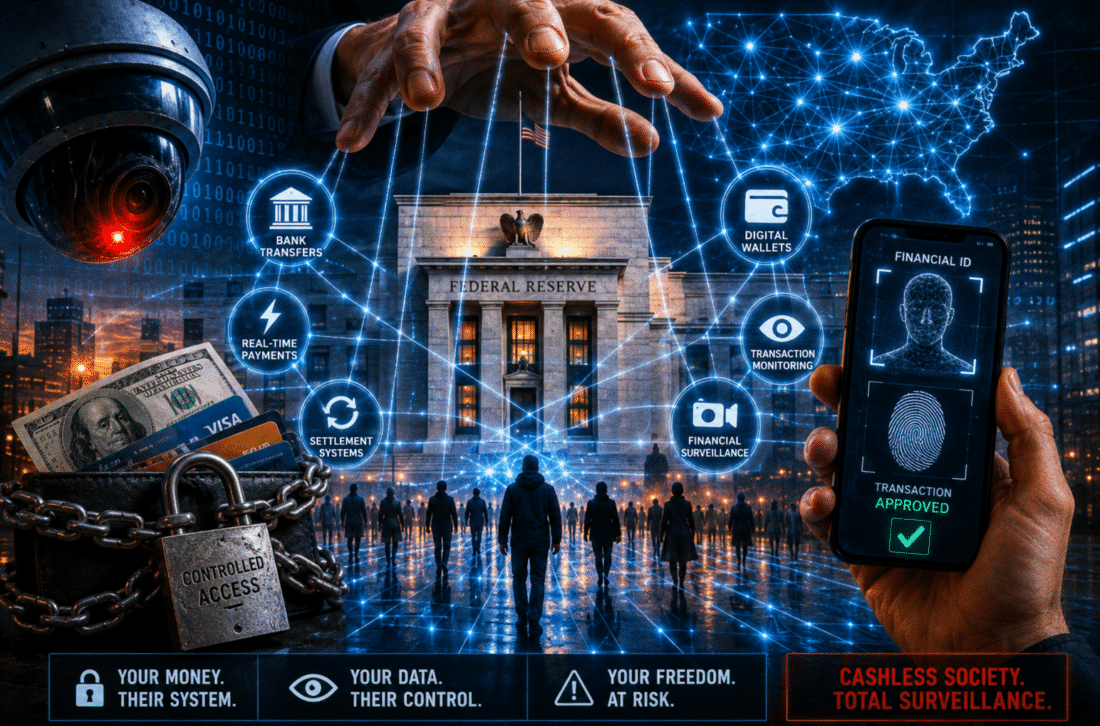
FedNow + Stablecoins = Real-Time Financial Visibility
Pair that with FedNow—the Federal Reserve’s real-time payment rail—and you’ve got a financial environment where:
- Transactions settle instantly
- Banking systems are fully interconnected
- Visibility increases by default
- Monitoring becomes continuous
No announcement. No dramatic rollout. Just gradual normalization.
The Missing Piece: AI Enforcement at Machine Speed
Now add the missing piece: AI.
Artificial intelligence isn’t just analyzing markets anymore—it’s actively scanning, monitoring, and stress-testing the digital infrastructure those markets depend on. That same automation is being used to:
- Flag suspicious transactions
- Enforce compliance rules
- Detect fraud patterns
- Intervene in real time
This is where stablecoins and AI intersect. You don’t need a centralized CBDC to create financial oversight when you have programmable digital assets moving across monitored networks.
The Invisible Control Layer Is Already Here
The control layer becomes:
- Distributed
- Embedded
- Largely invisible to the end user
Transactions can be analyzed, flagged, delayed, or blocked—not through a single switch, but through a web of interconnected systems operating at machine speed.
Meanwhile, physical assets like silver are being pulled further out of reach, redirected into strategic channels where they serve government and industrial priorities. That creates a widening divide between:
- Paper markets
- Physical availability
Prices might suggest one thing, but availability tells another story entirely. When premiums rise and supply tightens, that’s not noise—that’s the system signaling stress beneath the surface.
Final Warning: The System Is Already Changing
Forget the idea that this transformation will arrive all at once. It won’t. It’s already happening—through:
- Stablecoins
- AI-driven oversight
- Infrastructure like FedNow
The Mint shutdown was just a glimpse of what happens when physical supply collides with strategic demand. The bigger shift is happening in parallel, and it’s digital.
Take Action Before It’s Too Late
If you can see where this is heading—where physical assets are harder to access and digital systems are easier to control—then sitting on the sidelines isn’t a strategy.
You need to understand the playbook while there’s still time to act.
Download the Digital Dollar Reset Guide by Bill Brocius right now
This isn’t theory—it’s a breakdown of how the financial system is evolving and what you can do to protect your autonomy before the guardrails fully lock in.
Because by the time it’s obvious to everyone…
It’ll already be too late.